
Last November the Australian Journal of Defence and Strategic Studies published a review I wrote of Antulio J Echevarria II’s excellent book War’s Logic: Strategic Thought and the American Way of War.
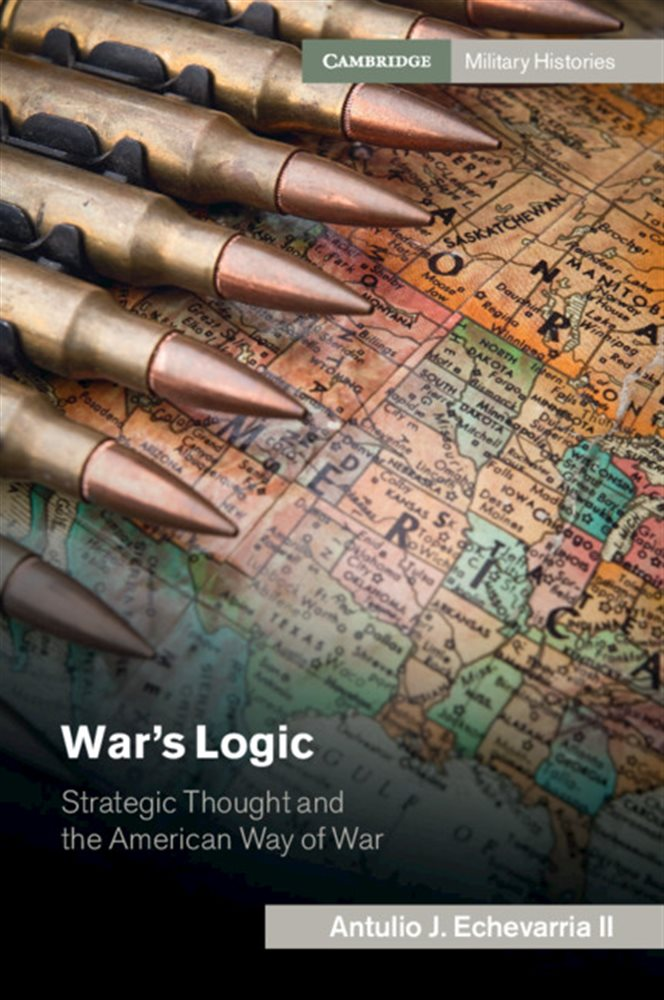
However, the review can be quite hard to find as the journal does not link to each article individually, only to the PDF of the entire edition. As the journal is published under a Creative Commons Attribution 4.0 license, I have created a separate PDF of the review itself to make it more accessible.
You can access the review here or read the beginning of it below.
The American way of war has always mattered greatly for Australia. Decisions made in the United States over when, and how, to wage war have long influenced Australia’s military fortunes. The American way of war has in turn depended on how American strategic thinkers have understood the logic of war, which has itself evolved over time in response to global politics, technological developments, intellectual trends and changes in American society. Antulio Echevarria’s new book, War’s Logic: Strategic Thought and the American Way of War, guides us through this tumultuous intellectual history. The book’s value lies both in what it reveals about American military thought and what it reveals about the logic of war itself.
War’s Logic explains the ideas of 12 American strategic thinkers from the late nineteenth century to the end of the twentieth century, who he divides into four groups.
First are the traditionalists, Alfred Thayer Mahan and Billy Mitchell, both military veterans and tireless enthusiasts of sea power and air power, respectively. Despite the different eras they wrote in, with Mahan 39-years older, they both brought Swiss theorist Antione Jomini’s core principles, prioritising offensive action, into their own military domains.
The second group are the civilian strategy intellectuals, Bernard Brodie, Robert Osgood, Thomas Schelling and Herman Khan. They gained prominence after the Second World War and prioritised the need to avoid a third world war given the transformative impact of nuclear weapons. New understandings of war’s logic followed: Brodie and Osgood’s promotion of limited war; Schelling’s view of war as bargaining and strategy as coercion (deterrence and compellence); Kahn’s advocacy of a nuclear escalation ladder that could itself function as a form of bargaining. Yet the apparent failure of limited war doctrine in Vietnam, along with the easing of Cold War tensions in the 1970s, reduced the influence of the civilian strategists.
This prompted the rise of Echevarria’s third group, the military intellectuals, Henry Eccles, J C Wylie, and Harry Summers. While the strategy intellectuals had been concerned with how to prevent military escalation (despite coercively wielding the threat of war for the purpose of bargaining), the military intellectuals restored space to focus on how to conduct war for the purpose of winning. Both Eccles and Wylie advanced the idea of strategy as control, an approach that Echevarria credits with synthesising both the traditionalist emphasis on offensive action with the civilian strategist emphasis on constraining military action to ensure it serves the purposes of policy. All three thinkers, particularly Summers, played a role in the post-Vietnam Clausewitz revival within the United States military.
The final group are the operational artists, John Boyd, William Lind and John Warden. These thinkers gained prominence in the 1980s and 1990s, when the idea that nuclear weapons made conventional war obsolete had lost its hold. Their priority was to create the intellectual foundations for the United States to once again wage war successfully. They restored the seemingly archaic idea of winning wars through winning battles, but with new twists. Boyd and Lind, respectively best known for the OODA Loop (observe, orient, decide and act) and Fourth Generation Warfare, sought to prioritise indirect attacks through the idea of manoeuvre warfare, where synchronised air and ground operations could use speed and surprise to overcome the need for grinding attrition. Warden promoted a different version of manoeuvre warfare based on air power, which paved the way for ideas such as effects-based operations. Like Eccles, Wylie and Summers, this group focused more on the conduct of war itself than th control of war through policy, but they went far further. In Echeverria’s account, Boyd, Lind and Warden’s ideas of prioritising operational art amounted to an intellectual insurrection.
This is the story that War’s Logic tells, and Echevarria is well suited to tell it. He is a professor at the US Army War College and brings both military and scholarly credentials to the formidable task of synthesising a nation’s strategic thought across a contentious century. …
If that sounds of interest, read the full review (about 4000 words including footnotes) here.
I should also mention that something went wrong with Footnote 30, and through some sort of Zotero accident I somehow pasted in a chunk of the blurb of the book I was citing. The footnote should simply say “Ben Mckelvey makes the argument that the US-led counter-network operations incentivised killing for its own sake and helped establish the context for the Australian war crimes.”
 The Murphy Raid