
In late March, Levi West and I published an article in West Point’s Combating Terrorism Center Sentinel on the Bondi terrorist attack of 14 December 2025: an act of antisemitic mass murder and the first Islamic State inspired mass casualty terror attack on Australian soil (after many failed plots and smaller attacks). It is one of the most consequential terrorist attacks involving Australia, alongside the 2002 Bali bombings and the 2019 Christchurch massacre.
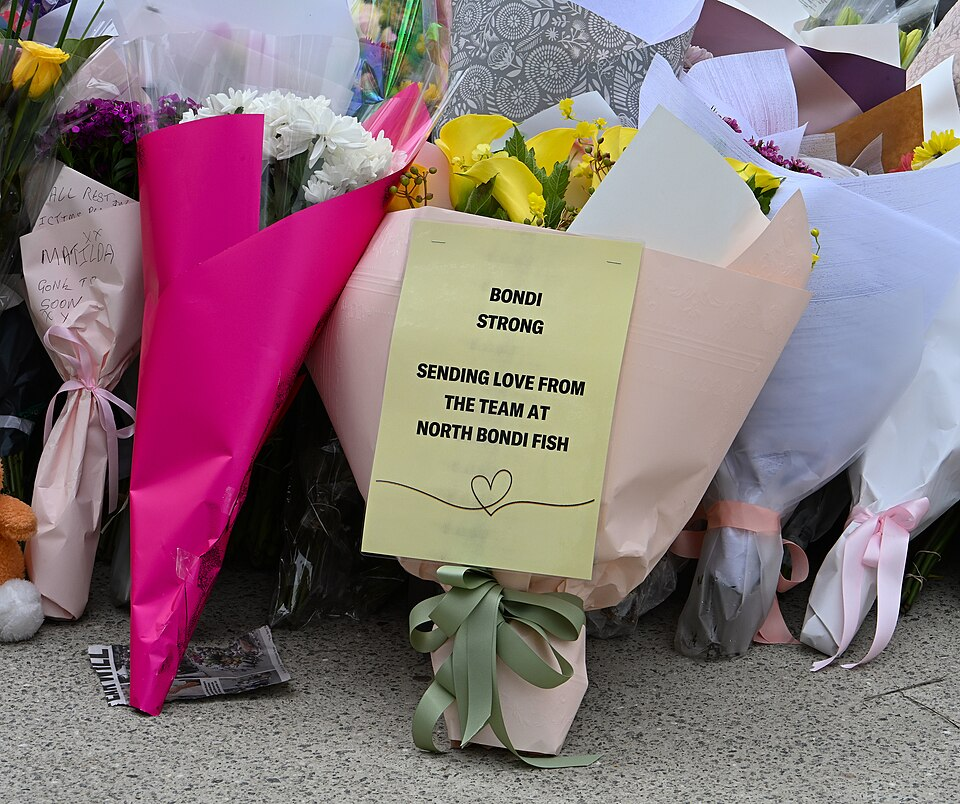
This horrific human tragedy has been widely examined from many angles, albeit with the court proceedings and a Royal Commission necessarily requiring limits on the information in the public domain.
Nonetheless, we sought to combine the currently available information with research on jihadist activity in Australia and on Islamic State’s global approach to transnational mobilisation, to contextualise the attack and propose a detailed first picture of how it came about:
On December 14, 2025, two men carried out a mass shooting and attempted bombing attack at Bondi Beach in Sydney, Australia. The attack targeted a Hanukkah celebration, killing 15 people and wounding 40 others. The terrorists unveiled two Islamic State flags at the scene as a precursor to the shooting. Within days, the Islamic State claimed—via its Al Naba newsletter—to have inspired the attack by having “consistently incited the targeting of Jews and Christians during their holidays and gatherings” and credited the attackers with having “answered the call and carried out the recommendations to target holidays and gatherings.” It was the 12th jihadi attack in Australia since the Islamic State declared its ‘caliphate’ in mid-2014, but its consequences were unprecedented, causing more fatalities than all earlier jihadi attacks in Australia combined. It was also the deadliest jihadi attack in a Western country since 2017, and the deadliest Islamic State attack targeting Jewish people in the movement’s history.
This article examines the antisemitic mass murder in Bondi in the context of prior Australian jihadi activity and post-October 7 shifts in the Islamic State’s approach to transnational mobilization. It first examines the attack itself, including the evidence of substantive planning and Islamic State inspiration. The article then situates the Bondi shooting in the context of over 25 years of jihadi activity in Australia, showing how it differs from earlier plots and attacks in crucial respects and what this means for the threat environment. The article also explains how the attack can be understood as an outcome of the Islamic State’s exploitation of the war in Gaza and its strategic adaptation in order to regain some global momentum. The article concludes by examining what is currently known about the radicalization and mobilization of the two men alleged to have carried out the attack, to help explain how such an unprecedented event occurred in Australia.
Since the article was published, some further information has become available. Levi and I will both be keeping track of these developments to update, and if necessary revise, our analysis. So far, some small snippets of information have come out on the radicalisation of the alleged attackers and their international travel.
Radicalisation and mobilisation
The Sydney Morning Herald has reported on some assessments of the alleged perpetrators’ radicalisation, saying that it involved a fixation on the Gaza conflict but through the lens of Islamic State ideology. This is not surprising in itself, given that the attack targeted Jewish people and involved the display of Islamic State flags, and is consistent with the argument made in our article that “in the global context the December 14, 2025, Bondi massacre can be understood as a consequence of the Islamic State’s post-2023 exploitation of the war in Gaza to remobilize its transnational support”.
However, the Sydney Morning Herald article fleshes this out at the individual level and emphasises the role of the father, Sajid Akram:
Security sources, including state and federal police, said Sajid’s role in organising the attack was far greater than publicly acknowledged.
His motivation, they said, was suspected to be his growing Islamic State-influenced anger about Israel’s conduct of its war in Gaza, where more than 70,000 people have died, which it launched after the Hamas terrorist attack in October 2023.
Sajid was a religious fundamentalist or “hardliner” for years before a relatively rapid descent into violent Islamic extremism and was absorbed by the Gaza conflict, one source said.
Another well-placed counter-terrorism official described Israel’s war in Gaza as a key motivator, while a third source aware of confidential assessments from state and federal agencies confirmed Sajid’s anger over Gaza, fused with the terrorist ideology of Islamic State, had contributed to the attack.
“He had views about Gaza,” the source said in reference to material gathered by state and federal agencies.
Court files say the pair recorded a video manifesto in October wearing black T-shirts and sitting in front of an image of an IS flag.
A source who had seen the video said Gaza was mentioned in the terrorists’ manifesto as part of their broader IS mission.
The contention that the father, Sajid Akram, was more radicalised than the son and exerted the strongest influence is consistent with earlier reporting by the ABC. It is also consistent with Sky News recently reporting that two National Security Hotline calls had been made about Sajid Akram years before the Bondi attack: one in 2007 alleging he was interested in explosives, and one in 2014 alleging he was interested in travelling to Syria to support Islamic State.
There has also been some further reporting on the family background of the alleged attackers, and on Naveed Akram’s association with a network of Islamic State supporters in 2019 (the el Matari network discussed in the second-last section of the CTC article).
Philippines travel
On the alleged attackers having travelled to the Southern Philippines island of Mindanao from 1 November 2025 to 29 November 2025, our article stated:
Scholars have noted that it is unlikely that foreigners could train with Islamic State-aligned groups in the southern Philippines in 2025, due to the improved security situation, and the AFP has stated that they found no evidence of the Akrams engaging in such training or logistical preparation. However, the AFP also made clear that they were not claiming that the Philippines travel was unrelated to the attack, with the Commissioner stating that the AFP were “not suggesting that they were there for tourism.” Most recently, Philippine authorities announced that they had arrested a Jordanian national in Mindanao for visa violations, and that he had a connection to the Akrams, but there is little further information.
Since then, it does not appear (at least publicly) that anything of significance has resulted from the arrest of the Jordanian national. Not long afterwards, local Philippines police declared that in their view the Akrams’ travel to Mindanao was “not connected to terrorist activity,” but with the caveat that “[m]aybe their intention in coming here was to get some training, but somehow along the way, it did not materialize”. Perhaps more will come out, but so far little light has been shed on the Philippines travel.
Central Asia travel
In our CTC article, we briefly refer to “an unconfirmed media report that, at some point before the Bondi attack, the two Akrams traveled to Central Asia with the aim of reaching Afghanistan, but were turned back in Kyrgyzstan.”
Since then, other media reports have supported the claim that the Akrams travelled to Central Asia. The Sydney Morning Herald article mentioned above states that “[r]etrospective analysis has also raised questions about whether the pair’s other historical travel to Central Asia – possibly as part of a plan to enter Afghanistan – was adequately analysed.” The ABC later reported that “[i]n the years before the attack, the Akrams travelled to Central Asia, where the influential Islamic State Khorasan Province branch operates.”
More recently, Sky News has reported that the Akrams travelled to Uzbekistan in either late 2022 or early 2023 (ABC later reported “around 2022”), and that they may have tried to reach Afghanistan on foot.
It will be interesting to learn more about this travel, given Islamic State Khorasan Province’s activity in Afghanistan and expansion across Central Asia during that period. Moreover, Isaac el Matari, part of the Islamic State support network that Naveed Akram had some association with in 2019, had sought (with the assistance of another network member, Radwan Dakkak) to travel to Afghanistan to join Islamic State Khorasan Province.
So more information on alleged attackers’ reported travel to Central Asia should be helpful for understanding the importance of Islamic State Khorasan Province, and its prominent publication Voice of Khurasan, to the jihadist terror threat in Australia.

