Some updates

I haven’t posted in a while, so this is just a few updates.

In early March I began a PhD in Political Science at Melbourne University, and am also now an Affiliate of the Melbourne School of Government. The PhD has meant that I have to to reduce my work at Monash and Swinburne, which will be reduced further over the next month or two.

So there might not be many posts on this blog for the near-future. I would love to be one of those people who can blog frequently while working and studying, but don’t think I am.

I won’t go into the PhD topic now, but will as my research progresses further. I’m currently  in the very enjoyable phase of exploratory reading.
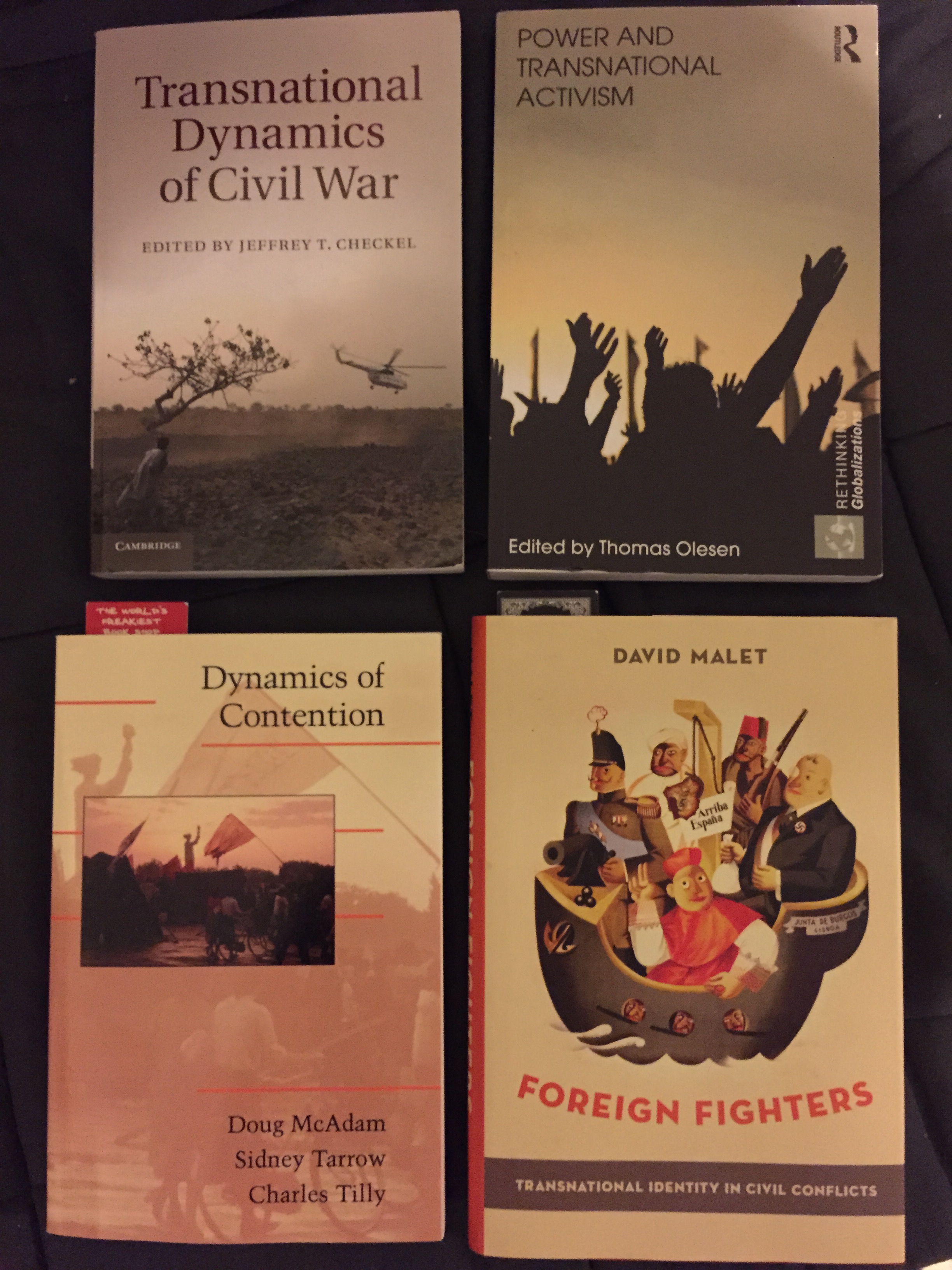
T books

M books

For a while now my research has mainly focused on Australian jihadism and I’ve been wanting to move beyond that. While I will still be doing research on that, it won’t be the focus of the PhD.

In other news, I had a paper published by the Lowy Institute recently: Australian Foreign Fighters: Risks and Responses.

Executive summary

Conflicts in Syria and Iraq have attracted aspiring jihadists from across the world. Australians have joined the flow of foreign fighters to the region, raising concerns that some will carry out terrorist attacks in Australia should they return home. The record of past jihadist foreign fighter mobilisations, including Australia’s own history in this regard, demonstrates that there is a potential threat to Australia’s security. However, a range of factors will shape that threat, including how Australia responds to returning foreign fighters.

The Government’s response has mainly focused on increased resources and powers for police and intelligence agencies, but also includes an important non-coercive element termed Countering Violent Extremism (CVE) that has received less attention. CVE has been a core element of the global response to foreign fighters, and has played a role in Australia’s counter-terrorism approach for several years. However, many past CVE measures are not directly suitable for the current situation. Australia can learn valuable lessons from European countries, which have more experience in CVE and are already using such measures to address the current foreign fighter threat.

I wrote this op-ed on some of the paper’s key points.

Also, there are some new journal articles out on foreign fighters (all paywalled though):

Daniel Byman, “The Homecomings: What Happens When Arab Foreign Fighters in Iraq and Syria Return?“, Studies in Conflict & Terrorism, published online 1 May 2015.

Cerwyn Moore, “Introductory Comments to Foreign Fighters Research: Special Mini-Series“, Terrorism and Political Violence, published online 5 May 2015.

Jasper L. de Bie, Christianne J. de Poot & Joanne P. van der Leun, “Shifting Modus Operandi of Jihadist Foreign Fighters From the Netherlands Between 2000 and 2013: A Crime Script Analysis“, Terrorism and Political Violence, published online 5 May 2015.

Richard Bach Jensen, “Anarchist Terrorism and Global Diasporas, 1878–1914“, Terrorism and Political Violence, published online 5 May 2015.

David Malet, “Foreign Fighter Mobilization and Persistence in a Global Context“, Terrorism and Political Violence, published online 5 May 2015.

Cerwyn Moore, “Foreign Bodies: Transnational Activism, the Insurgency in the North Caucasus and ‘Beyond’“, Terrorism and Political Violence, published online 6 May 2015.

Finally, my friend Matteo Vergani has started a new social science blog, called Why Don’t I Get Those Results? Take a look!


Two articles: militant use of YouTube, and Tony Abbott’s “death cult” rhetoric

Two new journal articles by my Monash colleagues. Enjoy!


Pete Lentini, “Demonizing ISIL and Defending Muslims: Australian Muslim Citizenship and Tony Abbott’s ‘Death Cult’ Rhetoric“, Islam and Christian–Muslim Relations, Volume 26, Issue 2, 2015

Abstract:

In the lead-up to Australia committing military resources and personnel to the coalition opposing the Islamic State in the Levant (ISIL), Prime Minister Tony Abbott consistently categorized the al-Qaeda splinter group as a “death cult.” Examining Abbott’s official rhetoric on ISIL and the threat it poses to Australia and the world, this article argues that his use of the term “death cult” reflects patterns in Western political demonology and demonizing enemies, namely, creating adversaries as monsters by highlighting the atrocities they commit in order to garner support for (often lethal) actions against them. In traditional political demonology, establishment representatives often target minority or marginal groups as these pariahs. However, in demonizing ISIL, Abbott deliberately made distinctions between it and its members and the majority of Muslims, including Australian Muslims, and utilized political demonology differently. In so doing, he affirmed this religious minority’s status within the parameters of Australian citizenship. This is indeed commendable. However, Abbott rarely mentioned Muslims outside of references to terrorism. Despite the fact that Abbott acknowledges that only a comparative handful of Muslims are indeed violent, he has not yet fully engaged with the broader notions of Australian Muslims’ contributions to Australian society and their citizenship.


Matteo Vergani and Dennis Zuevb, “Neojihadist Visual Politics: Comparing YouTube Videos of North Caucasus and Uyghur Militants“, Asian Studies Review, Volume 39, Issue 1, 2015

Abstract:

YouTube videos offer a rare opportunity to gain an insight into the sequestered world of neojihadism. This study examines and compares the lines of the visual narrative associated with two Asian insurgencies that help to form the global Islamic social movement: the insurgency in Chechnya (North Caucasus) and that in Xinjiang (China). The purpose of the article is to describe the narratives used by the Islamic militants addressing the conflict and to identify similarities and differences in the use of visual rhetorical techniques by neojihadist groups to propagate their worldview. The study of the visual narratives promoted in the videos will help to provide a better understanding of the impact of the neojihadist narratives on the creation of collective identities. Our findings suggest that these narratives have similar features, which can be identified in a set of sub-narratives. Within the common pattern, however, significant differences can be found, especially in the interpretation of the videos by the audiences.

Resources: Ukraine’s foreign fighters

Most discussions of foreign fighters (including on this blog) focus on Sunni Muslims joining ISIS, Jabhat al-Nusra and other jihadist groups to Syria and Iraq. But there are other interesting foreign fighter flows worthy of research attention. Phillip Smyth produced this excellent report on Shia Muslims joining Iranian-backed militias in Shia and Iraq. There are also people, often Westerners, travelling to join Kurdish groups in the region fighting against ISIS.

The Ukrainian conflict has also attracted foreign fighters. Since the war began in early-to-mid 2014, small numbers of foreigners have travelled to join extreme-right militias on both sides. This is not an issue I’ve been following much at all, so this post provides a brief collection of links for anyone else interested in it.

Media articles:

Ukraine: Far-Right Fighters from Europe Fight for Ukraine“, Eurasianet, 6 August 2014.

Ukraine War Pulls in Foreign Fighters“, BBC 1 September 2014.

Is Europe Overlooking the Far-Right ‘Foreign Fighter’ Issue in Ukraine?“, Huffington Post, 23 January 2015.

Reports:

Ukraine’s Far-Right Forces“, Hate Speech International, 3 February 2015.

Neither ‘NATO’s Foreign Legion’ Nor the ‘Donbass International Brigades:’ (Where Are All the) Foreign Fighters in Ukraine?“, PISM Policy Papers, 30 March 2015.

Resources: mapping terrorism studies in Australia

I recently revisited this 2006 assessment of terrorism studies in Australia by Stuart Koschade, which got me thinking about where you could start if you were to assess the field today.

I’ve put together this list of articles from 2003 onwards by Australian-affiliated authors from the journals Studies in Conflict and Terrorism and Terrorism and Political Violence, traditionally considered the core terrorism journals.

To be included, the article must:

  1. Have been published in Studies in Conflict and Terrorism or Terrorism and Political Violence.
  2. Be published at any point from January 2003 (the metadata was less clearly presented for earlier articles and finding them became time-consuming).
  3. Have at least one author listed as affiliated with an Australian institution.
  4. Must be a full-length article, not a book review or a reply piece.

This is far from a comprehensive overview of the terrorism research coming out of Australia. The list excludes other terrorism studies journals such as Critical Studies on Terrorism, Perspectives on Terrorism, Behavioral Studies of Terrorism and Political Aggression, Dynamics of Asymmetric Conflict, Democracy and Security and Policing, Intelligence and Counter-Terrorism. Also, lots of terrorism research is published in non-terrorism-specific journals (such as legal journals), in books, in government and think-tank reports, and elsewhere.

So there’s plenty of research by Australian authors missing here, such as the work of Leah Farrall. I may expand the list later on.

The articles are listed in reverse chronological order, and all are unfortunately paywalled.

Continue reading

Operation Pendennis, Abbott’s CT approach and law resources

I have two new articles out. One is a co-authored journal article in Perspectives On Terrorism, revisiting the terrorist plot foiled in 2005 by Operation Pendennis:

Operation Pendennis: A Case Study of an Australian Terrorist Plot
by Bart Schuurman, Shandon Harris-Hogan, Andrew Zammit and Pete Lentini

Abstract
This Research Note article provides a case study of a major Australian terrorist investigation, code-named Operation Pendennis. Drawing primarily from publicly available court transcripts, this study seeks to expand upon the growing literature within terrorism studies which utilises primary source materials. Its aim is to provide a detailed overview of Operation Pendennis that might serve as a resource for other scholars. The work also aims to add to existing knowledge regarding how terrorists prepare their attacks and react when under surveillance. This is done by providing a descriptive account of two cells’ preparations for an act of terrorism, and their unsuccessful attempts to evade authorities.

The other is an opinion piece in The Age, published a fortnight ago:

Abbott’s haste to tackle home-grown terrorists carries grave risks
by Andrew Zammit

The threat posed by Australians in extremist groups in Syria and Iraq is being used to justify dramatic changes to national security legislation. The threat is very much real, but that does not make all the proposed new laws necessary or justified.

The opinion piece expresses my fears, which have only increased in the past few weeks, that counter-terrorism in Australia is heading in a bad direction and returning to some of the worst aspects of the Howard Government approach. It looks like several of the Abbott Government’s new laws will be harmful, unnecessary, and will complicate counter-terrorism efforts.

I say “looks like” because there’s not much detail on the new laws, particularly the most contentious ones like reversing the burden of proof for suspected returning fighters.

So I’m linking to some extra resources on the laws, following up from the last post.

There are three sets of proposed national security legislation. The previous post contained resources on the first set, the five background reports, and some commentary.

Since then, the Parliamentary Joint Committee on Intelligence and Security has been conducting a short inquiry on the first set. Submissions to the inquiry can be found here, and transcripts of the public hearings can be found here.

Much less information has been released on the second set, aside from a press release and this press conference transcript.

The third set will involve data retention. No detail has been released on the government’s current plans for that, but there’s good background info in this Parliamentary Library paper from October 2012.

Finally, the Parliamentary Library recently released this useful paper: Counter-terrorism and national security legislation reviews: a comparative overview.

Resources: Australia’s new national security legislation reforms

Another quick post. Here are some resources for the impending reforms to national security legislation.


1. The Parliamentary page for the first set of reforms, National Security Legislation Amendment Bill (No. 1) 2014, is here. There will reportedly be a second set of reforms a few months later.

The key documents on that page are the bill itself and the explanatory memorandum.


2. Some commentary on the bill:

Bernard Keane, “Brandis’ national security bill a concern for whistleblowers, journalists“, Crikey, 17 July 2014 (currently paywalled).

Rebecca Ananian-Welsh, “National security bill gives ASIO more powers and a tighter gag“, The Conversation, 17 July 2014.

Cameron Stewart, “Security laws must be updated“, The Australian, 19 July 2014.


3. Five reports recommending national security legislation reform (the current bill is based heavily on the Joint Committee report, but the second set of reforms will apparently be partly based on the Independent Monitor reports and presumably the COAG one too):

Independent National Security Legislation Monitor – annual report 28th March 2014
Department of the Prime Minister and Cabinet (DPMC)
18 June 2014

Independent National Security Legislation Monitor – declassified annual report 20th December 2012
Department of the Prime Minister and Cabinet (DPMC)
14 May 2013

Council of Australian Governments review of counter-terrorism legislation
Council of Australian Governments (COAG)
14 May 2013

Report of the inquiry into potential reforms of Australia’s national security legislation
Parliamentary Joint Committee on Intelligence and Security (PJCIS)
24 June 2013

Independent National Security Legislation Monitor – annual report 7th November 2013
Department of the Prime Minister and Cabinet (DPMC)
12 December 2013


4. On Friday the Parliamentary Library published two lists of useful web links, one on national security and the other on crime and law enforcement.

Resources: five new reports on al-Qaeda, syria, jihadism and foreign fighters

Here are five think-tank reports on al-Qaeda, Syria, jihadism and foreign fighters that have come out in the past month.

I have not read any of them in full yet, but have read sections of the RAND and Brookings reports and definitely recommend them. The RAND one contains extremely useful data, regardless of questions about the media coverage of it, and gives a valuable historic overview of al-Qaeda and like-minded groups.

I’m looking forward to reading the foreign fighter reports, particularly as we’re passing the point where the threat from the Syrian foreign fighter mobilisation can be considered hypothetical. The Institute for Strategic Dialogue usually produces excellent reports, so I expect this one will be good. However I’m less keen on Quilliam, and am unfamiliar with the Soufan Group.

All these reports are free and in PDF format.


A Persistent Threat: The Evolution of al Qa’ida and Other Salafi Jihadists
RAND
4 June 2014

Foreign Fighters in Syria
The Soufan Group
2 June 2014

Dynamic Stalemate: Surveying Syria’s Military Landscape
Brookings Doha Centre
19 May 2014

Jihad Trending: A Comprehensive Analysis of Online Extremism and How to Counter it
Quilliam Foundation
12 May 2014

Foreign Fighters, the Challenge of Counter-Narratives
Institute for Strategic Dialogue
10 May 2014

Resources: information on Australia’s continuing detention of refugees who fail ASIO assessments

Last week the Federal Government, with the Opposition’s full support, passed legislation to keep around 50 refugees detained indefinitely.

These are people who have been found to legitimate refugees, but are still locked up for possibly the rest of their lives, because of adverse security assessments from ASIO. The legislation overrides a 2012 High Court ruling.

I’ve argued before that the security concerns could be well-founded, but that indefinite detention is unnecessary and unjustified. This post provides some links to resources for others opposed to this policy:


Immigration detainees with adverse security assessments v Commonwealth of Australia (Department of Immigration and Citizenship): Report into arbitrary detention and the best interests of the child
Australian Human Rights Commission
May 2013

Finds that the policy amounts to arbitrary detention, and that the Department of Immigration and Citizenship (DIAC) took no effort to explore whether detention was necessary for particular individuals, or whether less restrictive measures could address the security concerns.


Tell Me About: Refugees with Adverse Security Assessments
Australian Human Rights Commission
May 2013

Brief backgrounder explaining how the laws work and the human rights problems they raise.


Australia’s detention of 46 refugees ‘cruel and degrading,’ UN rights experts find
United Nations Human Rights Committee
August 2013

Press release containing links to two UN reports on this issue, which find Australia responsible for over 150 human rights violations.


Inquiry into the attendance of legal representatives at ASIO interviews, and related matters
Inspector-General of Intelligence and Security
January 2014

Casts doubt on ASIO’s conduct when interviewing refugees for security assessments. For example:

I found that the approach taken by ASIO officers (as generally described by officers that I interviewed) currently tends to a default of strongly discouraging the attendance of lawyers. I do not believe that this is consistent with ASIO’s stated internal guidance and may not be consistent with the legal requirements……

From all of the information provided to me, I believe that ASIO has had an apparent practice of discouraging the attendance of lawyers at interviews, which seems inconsistent with the intent of its internal guidance.


Factsheet: Refugees with an adverse security assessment by ASIO
Andrew & Renata Kaldor Centre for International Refugee Law
February 2014

Another backgrounder, but more up to date than the Australian Human Rights Commission one.


This is still breaking people: update on human rights violations at Australia’s asylum seeker processing centre on Manus Island, Papua New Guinea
Amnesty International
May 2014

This last resource doesn’t involve the ASIO security assessments at all. A couple of years ago, these 50-odd adversely-assessed refugees were the only people Australia was detaining indefinitely. Then in 2013 the Gillard government introduced “No Advantage”, and then we saw Rudd’s “PNG Solution”, followed by Abbott’s “Operation Sovereign Borders”. Now, Australia is in effect holding thousands of asylum seekers in indefinite detention (as their refugee claims are not being assessed).  This report outlines allegations of abuse in one of the detention centres, and the lack of response from Papua New Guinea or Australia.

Resources: four recent research reports on al-Qaeda

Following the massacre in Nairobi there’s been a spate of commentary about whether al-Qaeda has become stronger or weaker.

However, there’s little common agreement among commentators on what al-Qaeda is, which of its various affiliates and associated organisations should also be termed “al-Qaeda”, and what criteria should be used to assess strength or weakness.

You can be more informed by reading the following four think-tank reports, which all came out in the past month. They cover very similar territory to each other, but take differing approaches.


Jihadist Terrorism: A Threat Assessment
Bipartisan policy Center
9 September 2013

The al Qaeda Network: A New Framework for Defining the Enemy
American Enterprise Institute
10 September 2013

A New Index to Assess the Effectiveness of al Qaeda
Quilliam Foundation
12 September 2013

Al-Qaeda’s Global Footprint: An Assessment of al-Qaeda’s Strength Today
Henry Jackson Society
27 September 2013


Enjoy. Meanwhile, it doesn’t look like I’ll be returning to regular blogging soon.

Resources: datasets on jihadism updated

This is a list of sources for quantitative information on jihadist terrorism. It is an updated version of the list I posted in May last year.

It contains five new sources, and working links for everything (over half had broken).

Some of the links go directly to tables or charts, but most go to articles or reports that contain the dataset within. Most of the linked articles are in PDF format.

The sources are divided according to whether they focus on individuals involved in jihadism (usually covering demographic characteristics) or on jihadist incidents (covering things like methods of attack). Those that include both have been placed in the individuals section.

Within those categories, they are divided into whether they are free or behind paywalls.

A special note is made if the data is disaggregated. Those ones don’t simply say “45% of the sample was born in the US” but provide lists of each individual or incident, with specific details. These ones are the most valuable.

If you know of any good ones I’m missing, please let me know.


Jihadist individuals – open access

Altunbas, Yener and Thornton, John (2009) Human Capital and the Supply of Homegrown Islamic Terrorists in the UK, Social Science Research Network.

Atran, Scott (2009) John Jay & Artis Transnational Terrorism Database  Website which contains disaggregated data in excel sheets.

Bakker, Edwin (2006) Jihadi Terrorists in Europe, Clingendael: Netherlands Institute of International Relations.

Bergen, Peter et al (2010 but ongoing) Post-9/11 Jihadist Terrorism Cases Involving U.S. Citizens and Residents: An Overview, New America Foundation. Disaggregated.

Felter, Joseph and Fishman , Brian (2007) Al Qa’ida’s Foreign Fighters in Iraq: A First Look at the Sinjar Records, New York: Combating Terrorism Centre at West Point.

Fishman , Brian, ed. (2008) Bombers, Bank Accounts, and Bleedout: al-Qa`ida’s Road in and Out of Iraq, New York: Combating Terrorism Centre at West Point.

Gambetta, Diego and Hertog, Stephen (2007) Engineers of Jihad, London: University of Oxford.

Gartenstein-Ross, Daveed and Grossman, Laura (2009) Homegrown Terrorists in the U.S. and U.K.: An Empirical Examination of the Radicalization Process, Washington DC: Federation for Defense of Democracies.

Gilson, Dave et al (2011) “Terror Trials by the Numbers”, Mother Jones. See the disaggregated data here.

Hegghammer, Thomas (2013) “Should I Stay or Should I Go? Explaining Variation in Western Jihadists’ Choice between Domestic and Foreign Fighting“, American Political Science Review, Volume 107, Issue 1. The disaggregated data is available here and here.

Jenkins, Brian (2010) Would be Warriors: Incidents of Jihadist Radicalization in the United States Since September 11, 2001, Santa Monica, CA: Rand Corporation.

Kurzman, Charles (2011) Muslim-American Terrorism Since 9-11: An Accounting, Triangle Center on Terrorism and Homeland Security, 2 February. Disaggregated.

Kurzman, Charles and Schanzer, David and Moosa, Ebrahim (2010) Anti-Terror Lessons of Muslim-Americans, Washington DC: US Department of Justice, 6 January.

Zammit, Andrew (2011) “Who becomes a jihadist in Australia?” ARC Linkage Project Conference on Radicalisation Conference 2010.


Jihadist individuals – paywalled

Dyer, Emily and Simcox, Robin (2013) Al-Qaeda in the United States – A Complete Analysis of Terrorism Offenses, London: Henry Jackson Society. 107-page preview available for free, full report can be purchased in hard copy. Disaggregated.

Haddad, Simon (2010) “Fatah al-Islam: Anatomy of a Terrorist Organisation”, Studies in Conflict and Terrorism vol. 33, iss. 6, pp. 548-569.

Leikin, Robert (2006) “The Quantitative Analysis of Terrorism and Immigration: An Initial Exploration”, Terrorism and Political Violence, iss. 18, pp. 503-521.

Mullins, Sam (2011) “Islamist Terrorism and Australia: An Empirical Examination of the ‘Home-Grown’ Threat”, Terrorism and Political Violence, vol.23, iss. 2, pp. 254-285.

Porter, Louise and Kebbell, Mark (2010) “Radicalisation in Australia: Examining Australia’s Convicted Terrorists”, Psychiatry, Psychology and Law, June.

Simcox, Robin and Stuart, Hannah and Ahmed, Houriya (2011) Islamist Terrorism: the British Connections. 2nd Edition. London: Henry Jackson Society and The Centre for Social Cohesion. 32 page preview available for free, full report can be purchased in hard copy. Disaggregated.

Stenersen, Anne (2011) “Al Qaeda’s Foot Soldiers: A Study of the Biographies of Foreign Fighters Killed in Afghanistan and Pakistan Between 2002 and 2006”, Studies in Conflict and Terrorism, March, pp. 171 – 198.


Jihadist incidents – open access

Bjelopera, Jerome P. and Randol, Mark A. (2010) American Jihadist Terrorism: Combating a Complex Threat, Washington DC: Congressional Research Service, 7 December. Disaggregated.

Cruickshank, Paul (2011), The Militant Pipeline: Between the Afghanistan-Pakistan Border Region and the West, New America Foundation. Disaggregated.

Nesser, Petter (2010) “Chronology of Jihadism in Western Europe Update 2008-2010”, Working Paper, Kjeller: Norwegian Defence Research Establishment, 20 December. Disaggregated.

Sageman, Marc (2009) “Confronting al-Qaeda: Understanding the Threat in Afghanistan”, Perspectives on Terrorism, vol. 3, no. 4.

Europol (2007, 2008, 2009, 2010, 2011, 2012, 2013), Europol Terrorism Situation and Trend Reports, European Police Office.


Jihadist incidents – paywalled

Jordan, Javier (2012) “Analysis of Jihadi Terrorism Incidents in Western Europe 2001-2010”, Studies in Conflict & Terrorism, April, pp. 382-484. Disaggregated.

Nesser, Petter  (2008) “Chronology of Jihadism in Western Europe 1994–2007: Planned, Prepared, and Executed Terrorist Attacks”, Studies in Conflict & Terrorism, October, pp. 924-946. Disaggregated.

Crone, Manni and Harrow, Martin (2011) “Homegrown Terrorism in the West”, Terrorism and Political Violence, August, pp. 521-536. The disaggregated data is available here.