Did any Australians join the jihad against the Soviet invasion of Afghanistan?

I’ve often written about Australians who have joined jihadist groups abroad, but have rarely come across evidence of Australians fighting in Afghanistan in the 1980s.

Intuitively, you could expect that some Australians were involved in fighting against the Soviet occupation of Afghanistan. The 1979 Soviet invasion prompted tens of thousands of Muslims across the world to travel to Afghanistan and join the fight throughout the 1980s. This was the world’s largest jihadist foreign fighter mobilisation until the Syrian civil war.

Given Australians have joined jihadist groups in Afghanistan, Pakistan, Lebanon, Somalia, Yemen, Syria, Iraq and elsewhere since the 1990s, it would be surprising if there had been no Australians involved at all in the fight against the Soviets in Afghanistan.

Yet I have only occasionally come across indications of Australian involvement, such as a section in Irfan Yusuf’s book Once Were Radicals, where he states that in the 1980s a friend of his, Kamal, “seemed to know a lot of what was happening there [in Afghanistan], and he also knew people who had gone from Australia to fight in the jihad” (page 151).

Another example is that an Australian woman, Rabiah Hutchinson, travelled to Pakistan in 1990 and based herself in the village of Pabbi (near the Afghan border). She stayed under the auspices of Abdul Rassul Sayyaf (who trained many Jemaah Islamiyah terrorists) and interacted with Osama bin Laden. But this was after the Soviets withdrew, and bin Laden was (according to Hutchinson’s biography, The Mother of Mohammed) surprised to encounter an Australian. He reportedly said “Australian – that must be a first!” (page 191). This anecdote suggests that Australians were absent during the 1980s, but we can’t read too much into it. The story might not be true, and Bin Laden was not then the central figure he would later become, so we can’t assume he would have known the nationality of each of the thousands of volunteers who traveled to join the conflict.

So there has generally been extremely little information around on any Australians fighting the Soviets in Afghanistan.

However, Thomas Hegghammer recently sent me some interesting things he has found.

He found that “there were people in Australia reading al-Jihad and writing letters to the editor”. Al-Jihad was the magazine produced by Abdullah Azzam’s Services Bureau. Hegghammer provided this image of al-Jihad’s 18th issue, page 41:

AlJihadLetterToEditor.jpg large

He added that the “same guy is mentioned in the next issue (p.45) as having sent money.”

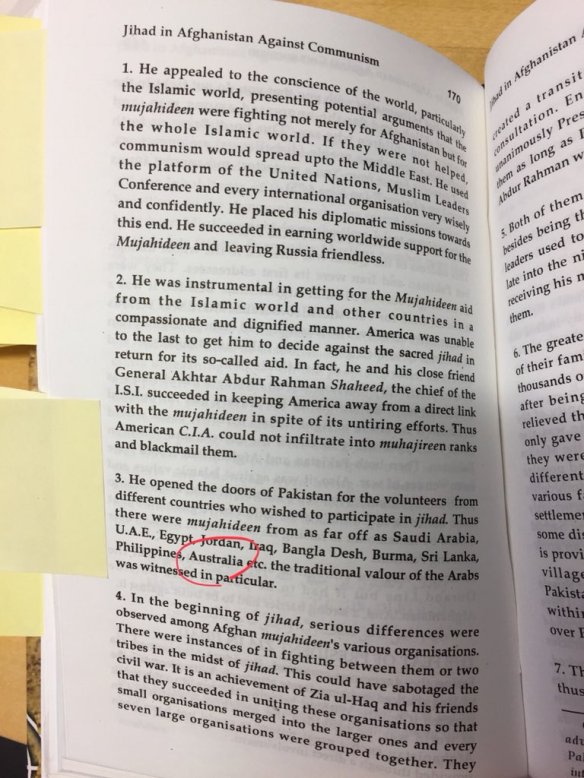
Hegghammer also showed that the book Jihad in Afghanistan Against Communism refers explicitly to Australians among the mujahideen at the time:

JihadCommunismBookCover.jpg large


JihadCommunismBookPage.jpg large

Hegghammer helpfully adds to the extremely small body of public information on any Australian involvement in the 1980s foreign fighter mobilisation against the Soviet occupation of Afghanistan.

It wouldn’t be surprising if a few Australians had been fighting the Soviets, but information on it is hard to come across, and I will let readers know if I hear of anything else.


Update 1: (added 29 March 2018) Anthony Davis from IHS-Jane’s has sent the following example. As with the examples above, I am not personally in a position to verify it, but I greatly appreciate it for adding to the small and fragmentary body of information on this topic:

l met a young Australian fighter called Yusuf while working in the northern Kunduz-Khanabad area in the late summer of 1982 with a group of mujahideen of the Jamiat-i-Islami party. He had served in the ADF and later married a Muslim woman from Malaysia and converted to Islam. He was actually less interested in killing communists than in fulfilling his duty as a Muslim to perform jihad. He took his religion extremely seriously rather to the amusement of his Afghan comrades-in-arms not all of whom prayed five times a day and many of whom enjoyed the odd joint of good local hash. They nick-named him “Sheikh” in a back-handed compliment to his religious rectitude. But with a full beard, long hair and turban, he otherwise fitted in well enough. At the end of the year he turned in his AK and joined me on the three week trek back to Pakistan. As far as I’m aware, he then returned to his wife in a kampong in northeastern Malaysia, having successfully ticked the ‘jihad’ box.


Guest post: the incarceration of radicalised prisoners in New South Wales

In this guest post, Katrina Zorzi discusses changes to the management of radicalised prisoners in New South Wales and what this might imply for Victoria and other states.

In the past year, the New South Wales government has ushered in a raft of changes to the management of radicalised prisoners. This post provides a short outline of these changes and offers some thoughts on an inspection by the NSW Inspector of Custodial Services, some recent changes that have been either implemented or proposed, and some of the national security and human rights dilemmas raised by this issue.

Goulburn Supermax

The rise and fall of the Islamic State’s ‘Caliphate’ and the apprehension of Australian-based IS supporters has increased the need for a workable, sustainable policy on incarcerating terrorists. In NSW, discussions around the incarceration of radicalised prisoners frequently centre on Goulburn’s ‘High Risk Management Correctional Centre’ Supermax facility.

There are reportedly 40-50 prisoners housed within the Goulburn Supermax. Not all are radicalised or terrorist inmates who are thought to be risks to national security (Ivan Milat, for one, is reportedly an inmate at the Supermax) though more than half are there on terror-related charges. In 2016 NSW Corrective Services Commissioner Peter Severin told The 7:30 Report that: “Supermax was built for extremely violent offenders… It wasn’t built and designed for people who pose a threat to national security.” The decision to house a broader array of radical inmates there reportedly dates from August 2015, when radical preacher Junaid Thorne – who was jailed for booking airline tickets under a false name – was transferred there. Individuals arrested in 2005’s Operation Pendennis, for example, which disrupted two terror cells in Sydney and Melbourne, were already housed in the Supermax.

Goulburn Supermax has gained a lot of media attention in the past few years, generally focused on the convicted and accused terrorists housed there. In 2016, anonymous senior counter-terrorism officials told The 7:30 Report of their concerns that youth terrorism suspects held within Goulburn’s Supermax facility were being further radicalised by extremist adult inmates. In April 2017 The Weekend Australian featured an article by Paul Maley, who had been given access to Goulburn Supermax, which featured insights from the Supermax’s intelligence unit and detailed the day-to-day living conditions of the radicalised prisoners. Last month it was reported that a prisoner within the facility had attacked and injured two guards.

One aspect that has not been reported on for some time is the inspection announced in 2016 by the NSW Inspector of Custodial Services.

The not-yet-public inspection

The NSW Inspector of Custodial Services (ICS) is a statutory agency tasked with “providing independent scrutiny of the conditions, treatment and outcomes for adults and young people in custody, and to promote excellence in staff professional practice”. The ICS has jurisdiction over all correctional facilities in NSW and an inspection can be initiated by either the Inspector, the Minister for Corrections, a Parliamentary Joint Committee or a public authority or official.

In April 2016, the ICS was tasked to undertake an inspection on the “Management of radicalised prisoners in the NSW correctional centres”. The centres identified to be examined in the inspection were: the Metropolitan Remand and Reception Centre, the Mid North Coast correctional Centre, the Lithgow Correctional Centre, the Goulburn Correctional Centre and its High Risk Management Correctional Centre.

However, it is not clear what has come of this inspection. In October 2016, the ABC reported that the review was expected to be handed down to the State Government in November. And, presumably, for it to be made public sometime after this. However, as of early March 2018, the report is still not publicly available on the ICS’s website. The ICS still lists the inspection into the management of radicalised prisoners as a ‘current inspection’.

Yet the ICS’s 2016-2017 annual report mentions the inspection in past tense, articulating that:

Pursuant to a request by the Minister for Corrections and in accordance with section 6(1)(f) of the Inspector of Custodial Services Act 2012, a review of the management of radicalised inmates in NSW prisons was commenced on 22 April 2016… The inspection examined approaches and practices relating to the risk assessment, classification, designation, placement, and management of inmates, conditions within centres, and offender programs and services. Over 200 CSNSW staff were consulted, as well as executive and specialist staff.

If it is not reading too much into the use of past tense it would suggest that the inspection has long been completed.

The 2016-2017 annual report also asserts that: “The ICS publishes all reports and responses to reports on its website”. That the inspection report is not publicly available might be for a few reasons. It might simply have not been posted on the ICS website as an oversight. It is also possible that publishing has been withheld on national security grounds, provisions for which are built into the Inspector of Custodial Services Act 2012. The lack of even a public statement on the inspection or a redacted version is disappointing, given the potential for ICS reporting to bring transparency to the way in which NSW deals with radicalised prisoners.

The remit of the ICS’s inspection into radicalised prisoners in NSW would suggest that they are housed in a number of prisons across the state, not just in Goulburn’s Supermax facility – despite the fact that most media reporting tends to focus on that prison. This relatively high level of media reporting might be due to the notoriety increasingly attached to that facility or a prison management decision to sporadically permit or encourage such reporting. Maley’s article thus offers a rather unique insight into the prison. In this way, Goulburn Supermax has perhaps been more subject to media scrutiny than other prisons situated within NSW corrections housing terrorist or radicalised inmates.

There have also been several changes announced in the NSW government’s approach, though it is impossible to know if they are a result of the ICS’s inspection.

Recent change: extended detention

In October 2017, ahead of the Council of Australian Governments (COAG) meeting on counter-terrorism in Canberra, the NSW government announced its intention to usher in measures that would allow the ‘indefinite detention’ of radicalised prisoners. In November the Terrorism (High Risk Offenders) Bill 2017 was passed in NSW state parliament, which complements laws introduced at the Federal level in 2016. Under the changes, an inmate in a NSW prison could be designated as a radicalised national security threat and be jailed for up to an additional three years. Radicalised inmates would undergo a rehabilitation assessment and a medical assessment presumably to determine whether they were still ‘radicalised’ and posing a threat to the community. The process to initiate this would be done at the behest of the state’s attorney general to the Supreme Court. There is the potential for these extensions to continue in perpetuity.

At the time, NSW Counter Terrorism and Corrections Minister David Elliott explained that evidence would be gathered from a range of agencies to determine whether a prisoner was radicalised and thus representing an unacceptable risk to the community. Such evidence “would include radical behaviour, letters, interactions, treatment of staff within the corrections establishment, treatment of other inmates”. Elliott went on to assert: “It is unfortunate that we have to introduce what are potentially the toughest anti-terrorism laws in the world – but what would be more unfortunate is if somebody who was radicalised in a prison and was then released and did harm.”

Why up to three years? It is not clear what the logic is behind this. Presumably it would be much more difficult for the NSW government to muster support for longer extensions to prison sentences given the human rights issues potentially at play. Whether there are current or viable future ‘deradicalisation’ or disengagement programs being run in the NSW prison system that authorities believe can work in three years or less is another potential consideration.

Another issue is that the concept of radicalisation – and thus the nature of what it means to be ‘radicalised’ too – is contentious. What the threshold for determining whether an individual is ‘radicalised’ and so constitutes an ongoing threat to national security is unclear. Whether there is room in this approach for an inmate to maintain a radical political ideology but disavow violence is also unclear. No doubt any declaration of the sort would be greeted by authorities with a healthy dose of scepticism.

Proposed change: new facility

The scale of this is set to increase, following the announcement last year that the NSW government was spending $47 million to build a new ‘mini-max’ facility within Goulburn’s Supermax for radicalised inmates. A logical inference would be that this is intended to address the problems raised by Severin (that Goulburn Supermax was built for violent offenders, not offenders who pose a risk to national security).

This is supported by Maley’s reporting in April 2017, which highlighted that Corrective Services NSW was looking at a ‘differentiated’ approach of separating radicalised inmates (presumably from the broader prison population) and also anticipated that the ICS report on the management of radicalised prisoners would make recommendations in favour of this too.

That $47 million will now be spent on a specialised facility within the Goulburn Supermax would suggest that, at least in part, the practice of centralisation and separation for radicalised inmates is being given a boost.

Proposed change: juvenile justice strategy

The changes continue, as in February this year the NSW government announced that it intended to create a ‘countering violent extremism’ unit within the juvenile justice system to designate and monitor youth inmates who constituted national security threats. It would also work to identify inmates ‘at-risk’ of radicalisation and involve them in ‘deradicalisation’ programs. NSW Premier Gladys Berejiklian highlighted that “this new strategy complements other initiatives such as our post-sentence detention scheme and stronger parole provisions”.

Further thoughts

The NSW government’s approach is not the only way to address this issue. There are some good media articles which articulate the different approaches taken by New South Wales and Victoria to managing offenders convicted of terrorism or terrorism-related offences. ANU’s Dr Clarke Jones and others have commented publicly and written at length on this topic. However, Severin expected that changes in Victoria might bring it closer to the NSW model. And recent reports also quote Victorian Premier Daniel Andrews as being supportive of having a federal prison facility solely for terrorist prisoners – in direct contrast to Victoria’s existing arrangements.

From a national security perspective, it is understandable that authorities are unwilling to risk releasing any individual they suspect still harbours violent extremist goals.

I am not convinced that complete transparency, for its own sake, is necessarily in the community’s best interest when it comes to national security. However, greater overtures could be made to transparency regarding the processes internal to the NSW government that have initiated these wide-ranging changes to policy and now practice. This is where the benefit of having strong mechanisms of oversight and public trust in institutions often kicks in. At the same time, of course, few people are going to be willing to go into bat for the rights and liberties of terrorists and the NSW government is probably quite confident of the public’s acceptance of such measures.

From a human rights perspective, things might look a bit different. Especially considering that some of these changes concern the incarceration of minors. We might expect that a new, purpose built facility for radicalised inmates will create qualitatively different conditions of life for inmates – for better or for worse. This aspect is much better commented on by someone with an advocacy, human rights or legal background.

But it is a good time to pause and take stock of the ways in which NSW deals with its incarcerated, radicalised population. We might also consider whether, for Victoria and other states, this represents the way of the future or a cautionary tale.

Katrina Zorzi is a sessional academic at Monash University, Charles Sturt University and Deakin University.

Three upcoming terrorism sentencings in Sydney

The NSW online court lists show that three men associated with two separate terror plots in New South Wales will be sentenced at the end of this week.

On Thursday 1 March at 2pm, Raban Alou and will be sentenced for his role in the October 2015 murder of NSW Police employee Curtis Cheng. He was accused of providing Cheng’s killer, 15-year old Farhad Jabar, with the handgun used in the attack. Alou pleaded guilty on 19 May 2017 to one count of “engaging in a terrorist act” for “aiding, abeting, counseling or procuring the commission of a terrorist act by Farhad Jabar Kahlil Mohammad”.

On Friday 2 March at 10am, Talal Alameddine will be sentenced for his role in the same attack. On 6 October 2017 he pleaded guilty to supplying the handgun that Alou gave to Jabar. He had some of the heavier terrorism charges withdrawn, but pleaded guilty to possessing the gun “connected with the preparation for a terrorist act, and being reckless as to that connection”.

On Friday 2 March, Tamim Khaja will be sentenced. He pleaded guilty on 29 October 2017 to “one count of planning, or preparing, a terrorist attack” for planning a mass shooting attack in Sydney, against targets such as “Timor Army Barracks at Dundas in Sydney’s north-west and the Sydney West Trial Courts at Parramatta”.


Update 1: (Added 7 March 2018) My mistake, Talal Alameddine was not being sentenced on Friday 2 March, he just had a sentence hearing.

Making sense of Home Affairs and counter-terrorism

Late last year the Department of Home Affairs was established as part of what Prime Minister Malcolm Turnbull called “the most significant reform of Australia’s national intelligence and domestic security arrangements in more than 40 years”. This post is to help keep track of what is being changed and what that means for Australia’s domestic counter-terrorism arrangements.

On 18 July 2017 Malcolm Turnbull announced that his government would create a new portfolio called Home Affairs, which would be responsible for all “immigration, border protection and domestic security and law enforcement agencies”. On 20 December 2017 the new Department of Home Affairs was formally established and its website became active.

However, new legislation is needed to complete the process, mainly to move the Australian Security Intelligence Organisation (ASIO) from the Attorney-General’s portfolio to Home Affairs. So on 7 December 2017 Turnbull introduced the Home Affairs and Integrity Agencies Legislation Amendment Bill 2017, which was referred on 8 December to the Parliamentary Joint Committee on Intelligence and Security, which is still reviewing it at the moment.

One immediate impact of all this is that ministerial responsibilities for counter-terrorism have changed.

Since the 1970s, the most important ministerial position when it came to counter-terrorism (aside from the Prime Minister) was the Attorney-General, who was responsible for ASIO and the Commonwealth Police Force (later the Australia Federal Police). This began to change in May 2015 when Turnbull gave Michael Keenan, who was already the Minister for Justice, the added role of Minister Assisting the Prime Minister on Counter Terrorism.

Now it has changed more radically, as the portfolios of Minister for Justice and Minister for Assisting the Prime Minister on Counter-Terrorism have been abolished and largely subsumed within the new portfolio of Home Affairs. Moreover, the Attorney-General’s portfolio has now lost most of its national security responsibilities, as they have been handed to Home Affairs. This puts most counter-terrorism responsibilities into the hand of the new Minister for Home Affairs, Peter Dutton.

Dutton will have other ministers helping to run the Department: the Assistant Minister for Home Affairs (Alex Hawke), Minister for Citizenship and Multicultural Affairs (Alan Tudge), and the Minister for Law Enforcement and Cyber Security (Angus Taylor). However, it appears that none of these junior ministers will have a counter-terrorism role. At a recent PJCIS hearing the Department’s Secretary, Michael Pezzullo, said that “the counterterrorism minister is Mr Dutton—and solely Mr Dutton”.

While the Attorney-General’s portfolio will have very few remaining national security roles, it will still be responsible for approving ASIO warrants. The Attorney-General will also take responsibility for some key accountability mechanisms, the Inspector-General of Intelligence and Security (IGIS) and the Independent National Security Legislation Monitor (INSLM). These bodies will be moved from the Prime Minister’s portfolio to the Attorney-General’s.

One question this raises is: what practical differences will these ministerial changes make for Australian counter-terrorism?

Looking from the outside, I would guess that it won’t change a whole lot. ASIO and the AFP will likely continue to function much as they were, as will bodies like the Australian Criminal Intelligence Commission (ACIC) and Austrac, as they are all statutory authorities. Also, much counter-terrorism is conducted by the States, coordinating with Federal agencies and departments through operational mechanisms like Joint Counter Terrorism Teams or broader structures like the Council of Australian Governments (COAG)’s Australia New Zealand Counter-Terrorism Committee.

However, with Dutton and Pezzullo in charge, I fear that the politics of counter-terrorism and national security will be dragged even more into the politics of immigration and national identity than they already are. James Button’s excellent Monthly article is worth reading for background on this.

There are also questions about whether creating this mega-department will reduce accountability, as former Attorney-General George Brandis reportedly alluded to in a recent speech to ASIO. Also, moving accountability mechanisms like the IGIS and the INSLM from the Prime Minister to the Attorney-General would appear to be downgrading their importance, and the IGIS is not keen on this move.

On the other hand, the Turnbull government has indicated that it would boost the powers and resources of these accountability mechanisms in line with the 2017 Independent Intelligence Review’s recommendations. We will have to wait and see what happens here.

Some updates on national security news and my research for 2018

Happy new year to all Murphy Raid readers!

This post is to announce a few bits of news.

First, Australia is going to experience major changes to its national security governance during 2018, with the Turnbull government creating the Department of Home Affairs, implementing recommendations from the 2017 Independent Intelligence Review, introducing new foreign interference laws, and in all likelihood passing more counter-terrorism legislation.

I’ll post occasional news round-ups, but a good way to track these developments is to follow the Parliamentary Joint Committee on Intelligence and Security’s inquiries. They are currently reviewing four bills yet to be introduced to Parliament:

In other news, Levi J. West and I have co-authored an article in Jamestown’s Militant Leadership Monitor on Neil Prakash, who was considered “the most important and the most dangerous” Australian member of Islamic State. We cover Prakash’s journey to the Islamic State, his role as a propagandist, his alleged involvement in terrorist plots, and his downfall. To read the article, you will need to subscribe to the Militant Leadership Monitor.

Meanwhile, I am still working on my book with Debra Smith on the history of terrorism and counter-terrorism in Australia, will resume my PhD in a few months, and am working on some small side-projects.

I will also keep posting here semi-regularly. I hope you find it interesting and useful, and thanks for reading!

An Australian terrorism news round-up: 4 November 2017

Here is a quick round-up of Australian terrorism-related news over the past month or so:

An Australian terrorism news round-up

There was a lot of terrorism-related news in Australia over the past week. Here is a quick round-up:

  • A co-conspirator behind the murder of NSW Police employee Curtis Cheng (by 15-year old Farhad Jabar) has pleaded guilty to a terrorism offence.
  • Musa Cerantonio and four other Victorian men, accused of attempting to leave Australia by boat to join an Islamic State affiliated group in the Philippines, have been committed to stand trial.
  • The brother of Khaled Sharrouf has been charged for allegedly resisting arrest when raided over suspicions he was violating a Firearms Prohibition Order. Khaled Sharrouf was involved in the terror plot foiled by Operation Pendennis in 2005, and after being released from prison he joined Islamic State engaged in highly public war crimes.
  • A South Australian man charged with advocating terrorism has pleaded not guilty.
  • An Australian facing terrorism charges in Bulgaria has asked the Australian government to provide help.
  • The inquest into the death of Numan Haider (a teenage Islamic State supporter shot death when stabbing two police officers) is nearing its end. Members of the Victorian Joint Counter-Terrorism Team contend that ASIO failed to pass on crucial information about the threat Haider posed.
  • It was announced that the 600-page report of the inquest into the Lindt Café siege in Sydney will be released next Wednesday. Four Corners will air a two-part special on the tragedy, beginning next Monday.
  • The Parliamentary Joint Committee on Intelligence and Security has published the submissions to its review of ASIO’s questioning and detention powers, which can be found here.
  • The Independent National Security Legislation Monitor held public hearings on Friday for its review of “Division 3A of Part IAA of the Crimes Act (Stop, Search & Seize powers); Sections 119.2 and 119.3 of the Criminal Code (Declared Areas); [and] Divisions 104 and 105 of the Criminal Code (Control Orders & Preventive Detention Orders)”. ASIO’s Director-General and the AFP’s deputy commissioner for national security spoke there, as did many legal figures and academics. A transcript should be on the website soon, and submissions to the review can be found here.

Update 1: Added the Numan Haider bit on 22 May 2017.

The homecoming of Australian jihadists: making sense of a “polarising and dividing” problem

Last week, Director-General of the Australian Security Intelligence Organisation (ASIO) Duncan Lewis predicted that more Australian jihadist fighters would return from Syria and Iraq and that managing them would prove a “polarising and dividing” issue:

Beyond the spectrum of public opinion, we can anticipate the effective and appropriate management of returning foreign fighters to be a polarising and a dividing issue in Australia… We have plans in place – they are currently being executed – to accept the return of foreign fighters, but it will be a polarising matter.

There has long been discussion of the potential terrorist threat posed by Australian jihadists returning from Syria and Iraq. So far, this has not been a major element of Australia’s terrorist threat. As I discussed in a recent CTC Sentinel article, the various attacks and plots Australia has experienced since September 2014 involved Islamic State (IS) supporters who had not left Australia. And the roughly 40 Australians who have returned from the region mainly did so before IS declared a “Caliphate” or targeted the West. These early returnees are not alleged to have been involved in terror plots.

However, the number returning is expected to increase in the near future. In February, Foreign Minister Julie Bishop spoke with US Vice-President Mike Pence about this, stating afterwards that such an increase is…

likely to be the consequence of military success in Iraq, for the example the retaking of Mosul…. That will mean that a number of foreign terrorist fighters will seek to flee from Iraq and the expectation is a number will seek to return home. We need to be prepared for that.

Bishop also discussed this with Indonesian President Joko Widodo during his recent visit to Australia.

In this post I outline some of the dilemmas involved in dealing with returnees, to help explain why it may indeed be the divisive issue that Duncan Lewis predicts. It covers why there is concern over returnees, what can be done, and makes some suggestions as to what should be done.


Why is there concern over returnees?

The concern is based on the well-founded idea that some Australians involved with jihadist groups in Syria and Iraq will be a serious terror threat on return. In past cases (such as the mobilisation to Afghanistan from the 1980s onwards) most returned foreign fighters did not end up becoming terror plotters, but a small proportion of them did, and were involved in deadly attacks such as the 2005 London bombings.

This has repeatedly been the case with jihadist returnees from Syria and Iraq. The November 2015 terror attack in Paris, which killed over one hundred, involved up to eight returnees. The March 2016 bombing in Brussels similarly involved returnees. Other attacks have also been perpetrated by returnees, as have many foiled plots.

However, it’s also important not to overstate the threat.

Australia is in a far safer position than Europe. Plots like those in Paris and Brussels were feasible because Islamic State had established a sophisticated underground infrastructure in Europe, enabled by various factors: Europe produced many more foreign fighters, has more porous borders, is geographically closer, and has greater strategic importance.

Australia has a much smaller number of potential returnees to worry about. Of those, some more might be killed or captured, while some others may choose to stay in the region or move elsewhere (such as Europe, the Caucasus or Southeast Asia) rather than try to return to Australia. Duncan Lewis noted that the number of returnees will likely be fewer than ASIO initially expected. Australia also has the advantage of having prepared for this for a few years, and being an island with few entry-points, making it hard for people to slip in unnoticed.

Nonetheless, if we do experience a surge in returnees, it will be a problem. Some could pose a direct terror threat and some could pose a security concern in other ways (such as forming new recruitment networks or inciting others). Most will have likely broken the law, but it may not be clear who poses the greatest threat and resources may be limited. This will create difficulty for those tasked with dealing with them, though they will have several tools available.


What can be done with returnees?

The Australian government will have the following options for dealing with them

  1. Strip their citizenship. Khaled Sharrouf, a prominent IS fighter who bragged about war crimes, has had his Australian citizenship revoked. I disagree with this power for multiple reasons, but the law has passed (with bipartisan support and popular approval) so the Australian government now has this option, and will likely use it several more times.
  2. Frustrate their return. In most cases, the Australian government will have cancelled their passports. To return to Australia, the suspect will need to gain a one-way travel document from an Australian consulate (presumably in Turkey). This is not likely to be a simple process, and authorities can use this to induce cooperation. It’s also possible that they will have broken the laws of other countries, and Australia may pass intelligence on to these countries to prevent the suspects returning.
  3. Prosecute upon return. Prosecution will be a preferred option, but it will often be difficult to prove their involvement beyond reasonable doubt, which is why an estimated 40 Australians managed to return without being prosecuted. However, some of these suspected fighters (Mehmet Biber and Muhammad Abdul-Karim Musleh) have now been charged, as authorities have had more time to gather evidence.
  4. Monitor and restrict. Authorities can closely monitor suspected returnees and take action if they engage in new criminal activity, terrorism-related or otherwise. They can also subject the returnees to special powers such as coercive questioning by the ASIO or the Australian Criminal Intelligence Commission, and Control Orders which place restrictions on a suspect’s liberty for up to a year.
  5. Countering Violent Extremism (CVE). Some returnees might be suitable for CVE efforts, which refers to non-coercive efforts to prevent (or undo) involvement in violent movements. This could be conducted by the Diversion Team within the Australian Federal Police’s National Disruption Group. Most returnees would not be suitable, as the Diversion team does not deal with those “too far along the path of radicalisation for early intervention to be effective or presents an unacceptable risk to the safety of service providers”, but some of the children might be.

CVE approaches take many different forms, and have been used widely in European countries, sometimes for dealing with returnees. However, as I’ve mentioned in this Lowy paper, some of their approaches would not be possible in Australia (at least without adjustments) as they would be seen as too soft.

This raises another question, the “polarising and divisive” issue ASIO chief Duncan Lewis referred to, which is what should be done.


What should be done with returnees?

So the government will have a lot of tools for dealing with returnees, but how should they be used? Should all returnees be prosecuted, to the full extent of the law, where possible?

For the most part, yes, particularly as this would be consistent with United Nations Security Council Resolution 2178, because the national security risk is real, and because the Islamic State has rightly earned the world’s hatred.

However, there is also debate (mainly in Europe, given the scale of the problem) over whether returnees should be shown some leniency to make the problem more manageable (see here and here). There is no simple answer, but my view is that some leniency should be shown in individual cases, depending on:

  1. Which group they joined. Was it a proscribed terrorist organisation like Islamic State or Jabhat al-Nusra (now Jabhat Fateh al-Sham, which leads the Hay’at Tahrir al-Sham umbrella group)? Those who joined groups that came under the Free Syrian Army banner or Kurdish anti-IS groups may still have broken the law, but should not be treated as severely as those who joined IS or al-Nusra.
  2. Whether they joined the group willingly. There may be cases where someone enters Syria with a vague idea of helping out in a humanitarian capacity but ends up being conscripted into an armed group. However, there could easily be cases where jihadists falsely claim to have been forced to join groups, so such claims should not be uncritically accepted. The “didn’t realise what I was getting into” argument is more plausible for those who travelled over during the conflict’s early years (2011-2013).
  3. Whether they were children or adults. The younger they are (and some are extremely young), the less responsible they are for their actions. Child soldiers have often been rehabilitated and gone on to be outstanding citizens, including in Australia.
  4. What role they played in the group. Was it a combat or non-combat role? Was it a major or minor role? Did they call for attacks outside the conflict zone? Did they engage in atrocities? Many Islamic State fighters have raped, tortured, murdered and mutilated people in Syria and Iraq. There should be no leniency at all for war criminals.
  5. Whether they willingly cooperate with authorities. This is the most important factor. Those who do not cooperate (such as by providing intelligence or helping stop others from becoming involved) cannot expect to escape the full extent of the law. However, those willing and able to help should be given some leniency, particularly if there is a strong chance that it will saves lives.

So the potential surge of Australians returning after being involved with jihadist groups in Syria and Iraq will be a difficult problem, and has no single solution.

Generally, those who can be proven to have broken the law should be prosecuted. In most cases, any leniency should only come into play after they have been prosecuted (by taking it into account when sentencing). In a few cases, leniency should be an alternative to prosecution (such as for some of the children or those who become informants). And unfortunately in many cases prosecution will not be possible, leaving authorities with a range of imperfect options.

Intelligence services, police, prosecutors and judges will have to make these difficult judgements. Political leaders should make sure they have the flexibility to do so, by avoiding the temptation to announce some sort of blanket policy, no matter how “polarising and dividing” the issue becomes.

Upcoming national security and international relations events in Australia

28-30 March (Sydney): Public Venue Security and Safety Summit 

30-31 March (Melbourne): Keyboard Warriors? Military operations in the Information Age – Opportunities and Challenges (free)

4 April (Canberra): Book launch for China Matters: Getting It Right for Australia (free)

4 April (Canberra): Book launch for The Long Road: Australia’s Train, Advise and Assist Missions (free)

4 April (Melbourne): States, Violence and the West – What al-Qa’ida means in Yemen, presented by Dr Sarah Phillips (free)

4-5 April (Canberra): Women and National Security Conference

6 April (Melbourne): Fighting Terrorism in Iraq, presented by the Honourable Dr Hussain Mahdi Al-Ameri, Iraqi Ambassador to Australia and New Zealand (free)

12 April (Melbourne): The Australian Intelligence Community – Its Governance Amidst Widening Demands, presented by Ashton Robinson (free)

19-20 April (Sydney): 2017 Safety, Security and Counter-Terrorism Forum – Uncover Evolving Threats, Protect Critical Infrastructure and Respond With Effective Crisis Communications

3-4 May (Canberra): Safeguarding Australia 2017 – The 4th National Security Annual Summit

12-13 May (Brisbane): War in the Sand Pit: conference on Afghanistan & Iraq

6-7 June (Brisbane):  Annual National Policing Summit – Strategy, Leadership and Modernisation within Crime and Terror Prevention

18 July (Canberra): Australian Security Summit 

26-28 July (Sydney): Security Exhibition & Conference

29-30 August (Canberra): 15th Annual National Security Summit – Policy, Surveillance & Interoperability

Far-right violent extremism in Australia: what’s new?

Yesterday, an alleged terrorist had a hearing at the Melbourne Magistrate’s Court. He had been arrested in a Victorian Joint Counter-Terrorism Team raid on 6 August. Counter-terrorism raids in Australia are usually directed against suspected jihadists, but this time the suspect was on the extreme right. Investigators said he had been:

linked to the far-right groups Reclaim Australia, United Patriots Front, Patriots Defence League Australia, the True Blue Crew and a ‘neo-Nazi, self-confessed militant group’ called Combat 18.

He allegedly planned to make improvised explosive devices and targeted left-wing activists. He was charged with Commonwealth terrorism offences and the allegations will all be tested in court.

After he was arrested, Justice Minister Michael Keenan noted that this was the first time terror charges had been used against someone on the extreme right.

I want to disentangle what is, and is not, new about this.

The alleged plot, if proven, would not be the first case of far-right violent extremism in Australia. To choose some recent examples, in 2010 self-described Combat 18 members fired shots at a mosque in Perth. In 2012 two Melbourne neo-Nazi skinheads were sentenced to jail for brutally assaulting a Vietnamese student.  In 2013 a former soldier and self-described neo-Nazi was jailed for weapons and explosives offences. Most recently, a reported white supremacist was charged for allegedly setting fire to a church, though again it’s important to presume innocence and wait to see what comes out in court.

However, what’s unusual about the arrest is that far-right violence in Australia doesn’t usually reach a threshold where terrorism legislation can clearly be applied. Someone with particular beliefs engaging in violence does not automatically become terrorism under Australian law. The law is quite specific and makes it hard to prove a terrorist act (or planning or preparation for one) because it depends on intentions.

In terrorism cases, the prosecution must prove beyond reasonable doubt that:

(b)  the action is done or the threat is made with the intention of advancing a political, religious or ideological cause;

They must also prove that:

(c)  the action is done or the threat is made with the intention of:

(i)  coercing, or influencing by intimidation, the government of the Commonwealth or a State, Territory or foreign country, or of part of a State, Territory or foreign country; or

(ii)  intimidating the public or a section of the public.

A subsection then states that an act does not count as terrorism if it:

(a)  is advocacy, protest, dissent or industrial action; and

(b)  is not intended:

(i)  to cause serious harm that is physical harm to a person; or

(ii)  to cause a person’s death; or

(iii)  to endanger the life of a person, other than the person taking the action; or

(iv)  to create a serious risk to the health or safety of the public or a section of the public.

So proving a terrorist act doesn’t only require evidence of someone’s actions but a lot of evidence about their intentions. This often requires the prosecution to present recordings of conversations between suspects, intercepted during long pro-active investigations.

The current case appears to be the first time, since terrorism offences were introduced in 2002, that authorities had the sort of evidence against a suspected far-right violent extremist that would enable terrorism charges. Usually they have been dealt with through other laws such as assault, weapons possession, and criminal damage.

In that sense, this is a new development. But this does not mean that the alleged plot, if proven, should be regarded as the first case of far-right terrorism in Australia.

First, there are many definitions of terrorism and there is no intellectual obligation to stick to purely legal definitions. There will always be political debate over what is and isn’t terrorism.

Second, some cases of far-right violent extremism before 2002 amounted to terrorism even though we did not have specific terrorism legislation at the time. For example, the first fatal terrorist attack in Australia this century was Peter James Knight’s attempted anti-abortion massacre in 2001. There was also the Australian Nationalists Movement’s wave of violence in Perth in the late 1980s, for which the judge said when sentencing:

It is, in my view, no overstatement or exaggeration to term your campaign of those months a terrorist campaign and again it is no exaggeration to say that in that period you waged a guerilla war against the public.

Another issue also makes the current case less of a remarkable development. The potential for renewed far-right terrorism in Australia had been apparent for a while, particularly as such activity had increased elsewhere.

In the early 2010s, far-right terrorism became a bigger issue in Europe. Prominent incidents included the murders of 69 people in Norway by Anders Behring Breivik in 2011, alleged Breivik-copycat attempts in Poland and the Czech Republic, the murder of two Senegalese street vendors in Italy by someone linked the far-right CasaPound. There was also the exposure of the National Socialist Underground, responsible for a murder spree across Germany from 2000 to 2007. In the UK, far-right extremist Pavlo Lapshyn murdered a Muslim man and bombed several mosques in 2013, and there was a reported extreme-right connection to the recent murder of popular MP Jo Cox.

There was a similar surge in the United States, with the most visible examples being the murders of six people in a Sikh temple in Wisconsin by a member of the neo-Nazi Hammerskins in 2012, of three people at a Kansas Jewish centre by a white supremacist in 2014, and of nine people in an African-American church in Charleston by white supremacist Dylann Roof in 2015. In October of this year, the FBI foiled an alleged terror plot by self-styled “Crusaders” to murder Somali immigrants.

Australia has traditionally experienced much less of this, but as such violence became more prominent in Europe and America, agencies expressed concern about the situation here. The ASIO annual report for 2010-2011 noted:

There has been a persistent but small sub-culture of racist and nationalist extremists in Australia, forming groups, fragmenting, re-forming and often fighting amongst themselves…. Local racist and nationalist extremists maintain links and draw inspiration from like-minded overseas extremists, and much of their rhetoric and activity is derivative, heavily influenced by developments overseas.

Of course, developments in Australia do not necessarily follow those abroad. ASIO’s next annual report concluded that:

Over the reporting period, the rise in right wing extremism in parts of Europe was not reflected, nor did it gain large-scale support, in Australia.

Unfortunately, that no longer appears to hold true. In the most recent Senate Estimates hearings, ASIO Director-General Duncan Lewis made that clear:

Senator  McKim: Mr  Lewis,  I  just  want  to  follow  up  on  my  last  question.  Would you say that the threat to national security from radical anti-Islamic groups in Australia is growing at the moment?

Mr Lewis: Yes, off a very low base. It has come off a low base. But it has presented, really, probably in the last 18 months or so. So, yes, it is, but I would not describe it as going up in any vertical way. But it has come off a low base and it is now more present than it was.

By “threat to national security” they would be referring to violence or the potential for violence (non-violent protest is not a national security concern under ASIO’s charter, and they are obviously not referring to national security threats like espionage).  This suggests that ASIO’s view is that the far-right violent extremist threat is not large but has recently become larger than it was.

What does all this tell us about this significance of this counter-terrorism prosecution?

Mainly, that it is only a new development in one sense. The use of Commonwealth terrorism offences against an Australian extreme-right activist is unprecedented.

However, terrorism legislation only covers a specific subset of violent extremism; usually that for which the authorities have enough evidence to prove a plan for life-threatening violence intended to intimidate a wider audience to further a political cause. That the legislation was never used before against anyone on the extreme right did not mean there was no potential threat.

Australia had experienced far-right violent extremism before, including quite recently. We experienced more of it, sometimes amounting to terrorism, further in the past. Far-right violence had escalated in Europe and America and many, including security agencies, were concerned it could escalate here.

For these reasons, while an Australian counter-terrorism prosecution against a suspected far-right extremist is a new development, it should not be a surprising one.