Internal assessments of terrorism studies

I’ve recently been making notes on the fields of terrorism studies, civil war studies, and social movement studies, looking at assessments from both people within these fields and people outside of them. When looking at the internal assessments of terrorism studies, two things stood out.

  • The assessments are usually very negative about the field’s methodological rigour
  • They’ve become much more positive in the past five to ten years

I had already been aware of the first point. Terrorism studies has regularly been accused, by its own leading scholars, of poor research quality. As Lisa Stampnitzky has written:

It may not seem surprising that the production of knowledge about such a contentious subject would attract external critiques. What is more deeply puzzling, however, is that some of the harshest and most frequent laments have come from the practitioners of terrorism studies themselves. Terrorism researchers have characterized their field as stagnant, poorly conceptualized, lacking in rigor, and devoid of adequate theory, data, and methods.

However, I hadn’t been aware earlier of the second point, the trend towards a more positive outlook. So this post is to show how internal assessments of terrorism studies have gradually become more optimistic.

Examples of the earlier, strongly negative, assessments are easy to find. Alex P. Schmid and A. J. Jongman famously wrote in 1988 that:

There are probably few areas in the social science literature in which so much is written on the basis of so little research. Perhaps as much as 80 percent of the literature is not research-based in any rigorous sense…

Over fifteen years later, Andrew Silke reviewed the output of two core terrorism journals (Terrorism and Political Violence and Studies in Conflict and Terrorism) between 1995 and 1999, and concluded that:

Ultimately, terrorism research is not in a healthy state. It exists on a diet of fast food research: quick, cheap, ready-to-hand and nutritionally dubious…. A limited range of methodologies in data gathering, combined with a reluctance to use more rigourous analysis, has left the field with serious deficiencies in many respects. Ultimately the methods used by terrorism researchers are essentially exploratory.

In 2005 John Horgan published a book on the psychology of terrorism, extensively reviewing the literature at the time. He later reflected:

I concluded on a depressing note. The psychology of terrorism, I argued, was at best under-developed, and at worst doomed to the mercy of unrealistic expectations of those who seek quick and simple solutions to the terrorism problem. Asking counterterrorism practitioners to consider contributions from the academic literature on terrorism was, at best, a half-hearted recommendation. Yes, there was a lot of quality research out there, but the unending torrent of drivel made it ever more impossible to keep oneself afloat.

But recently there has been a shift. Within the past five to ten years, the internal assessments have become more optimistic. The same scholars who issued such damning critiques have found considerable improvement.

For example, Alex P. Schmid’s most recent review of the literature argued that:

Looking back over four decades of terrorism research, one cannot fail to see that, next to much pretentious nonsense, a fairly solid body of consolidated knowledge has emerged. In fact, Terrorism Studies has never been in better shape than now…. Terrorism Studies — despite many shortcomings — has matured.

Silke’s most recent review, covering two core journals from 1990 to 2007, also found reasons for optimism. He argued that:

There are signs that research published in recent years is less opinion-based and more rigorous in methodology and analysis…. The use of inferential statistics on terrorism data in particular has nearly quadrupled since 9/11, a trend which can only help improve the reliability and validity of the conclusions being reached by researchers.

He more recently suggested, along with co-author Jennifer Schmidt-Petersen, that terrorism studies was experiencing its golden age:

Indeed, far from being stagnant or moribund, terrorism studies is arguably enjoying a golden age. High impact articles are appearing at a rate never before seen, and the core knowledge of the area is shifting and coalescing around new research and theories.

John Horgan’s 2014 update of his 2005 study also noted the field’s improvement:

So what has changed? In the intervening 8 years, there is much to commend. For a start, the field is no longer dominated by the small handful of researchers who traditionally characterized what is now commonly known as ‘terrorism studies’ (just don’t call it a discipline). Fortunately, the increase in interest from the social and behavioral sciences has also mirrored an increase in solid, quality research output. In fact the creep of systematic, interdisciplinary research on terrorist behavior has meant that it is certainly getting easier to distinguish opinion from analysis, and snake-oil conjecture from analysis that is informed by empirical evidence.

Similarly, Peter Neumann and Scott Kleinmann recently examined the rigour of ‘radicalisation research’, which can be considered a subset of terrorism research. Their findings were also positive:

Overall, the results are not as damning as one might have expected based on Silke’s and Schmid and Jongman’s earlier surveys of the terrorism studies literature. It would not be justified, therefore, to say, as Schmid and Jongman did in 1983, that the entire field is “impressionistic, anecdotal, [and] superficial.” On the contrary, there is much to be encouraged by, not least the fact that more than half of the items in our sample scored “high” in relation to either empirical or methodological rigor, and more than a quarter (27 percent) did so in both.

They also raise issues with Silke’s critique, arguing that it uses too narrow a definition to determine rigour:

For example, Silke classifies nearly all document-based research as “secondary source,” which effectively dismisses entire academic disciplines and methods—especially historical research—as methodologically and empirically inadequate.

They also question Silke’s emphasis on the use of statistics:

Indeed, for “micro phenomena” such as terrorism and radicalization, the use of qualitative methodologies—such as detailed case studies and narratives—may, in many cases, be more appropriate and produce more valid results than the construction of large—and largely meaningless—datasets. This, of course, is no excuse for laziness and sloppy research, which—disturbingly—could be found in many historical studies in our sample. But it suggests that it would be misleading to believe that quantitative research with large datasets, which—from a strictly methodological point of view—may be cleaner and more rigorous, is necessarily also the kind of research that will produce the most relevant insights about the phenomenon that radicalization research seeks to understand. Given the “micro” nature of the subject, the lower share of studies that draw on large amounts of empirical evidence—and, consequently, the less extensive use of quantitative methods, inferential statistics, etc.—must not necessarily be a cause of concern.

So on the whole, internal assessments of terrorism studies to be more optimistic about the field today than ten or more years ago, and find huge improvement.

This view isn’t universal. Marc Sageman recently argued that the field had stagnated, prompting responses from Max Taylor, Alex P. Schmid, David H. Schanzer, Clark McCauley, Sophia Moskalenko, and Jessica Stern, followed by a rejoinder from Sageman. And all the assessments mentioned in this post still note extensive problems with the field. Peter Neumann and Scott Kleinmann’s assessment ended by noting that:

Yet, despite clusters of excellence, there remains a significant amount of research that fails to meet minimum standards of scholarly work. In most disciplines, having 34 percent of published research that is either methodologically or empirically poor would be considered unacceptable, yet in terrorism studies—and radicalization research more specifically—this state of affairs has been allowed to persist.

This all leaves the question of why, despite improvement, there is plenty of sub-par research. There’s a lot of writing on this,  I recommend three articles in particular.

The first is an external assessment, from the earlier-mentioned Lisa Stampnitzky, who is a sociologist who the studied the field itself. In this article she describes how terrorism studies, rather than functioning as a purely academic field, awkwardly straddles academia, the media and the state. The second is Magnus Ranstorp’s introduction to the book Mapping Terrorism Research, which provides a good outline of the field and some of its problems. The final one is Thomas Hegghammer’s conference paper on the future of terrorism studies, which gives good advice on how current researchers can help progress the field.

Fred Halliday on the Iraq war’s legacy

I’m re-reading a lot of Fred Halliday’s work (Middle East scholar at LSE until his death in 2010), mainly his collection of openDemocracy essays. One part in this 2007 essay really struck me, when he outlined some long-term consequences from the 2003 invasion of Iraq.

It has already set in train six major processes, which will take years to work themselves through:

  1. the wholesale discrediting of the US, its allies, particularly Britain, and any campaign for the promotion of democracy in the Arab world
  2. the unleashing across the middle east, and more broadly within the Muslim world, of a revitalised militant Islamism, inspired if not organised by al-Qaida, which has used the Iraq war greatly to strengthen and internationalise its appeal
  3. the shattering of the power and authority of the Iraqi state, built by the British and later hardened by the Ba’athists and the fragmentation of Iraq into separate, antagonistic, ethnic and religious zones
  4. the explosion, for the first time in modern history, of internecine war between Sunni and Shi’a in Iraq, a trend that reverberates in other states of mixed confessional composition
  5. the alienation of all sectors of Turkish politics from the west and the stimulation of an authoritarian nationalism there of a kind not seen since the 1920s
  6. the fomenting, albeit in slow motion and with some constraints, of a new regional rivalry, between two groupings: Iran and its allies (including Syria, Hizbollah and Hamas), versus Saudi Arabia, Egypt and Jordan – a rivalry made all the more ominous and contagious by Iran’s pursuit of nuclear weapons.

Sadly, this stands up well today.

Syria update and new articles

The most recent Senate Estimates hearings have given us the latest official figures on Australians involved with jihadist groups in Syria and Iraq.

These are:

  • 120 Australians are currently fighting or are engaged with terrorist groups in Syria and Iraq.
  • At  least  32  and  potentially  up  to  42  Australians  are  believed to  have potentially  been  killed  in  the  conflict  to  date.
  • Approximately  30  Australians  have  returned  from  the  conflict.
  • About  170  people  in  Australia  are  providing  support  to  individuals  and  groups  in  the  Syria  and  Iraq  conflicts through  financing  and  recruitment,  or  are  seeking  to  travel.

(these are direct quotes, from page 121 of this transcript)

The figure of 120 currently over there has been static for months, as has the figure of 30 having returned. But the figure of up to 42 deaths is higher than previously reported. My own count based on public sources is only 27, and it includes a few doubtful ones. So there’s likely far more going on than we can see.

Meanwhile, I’ve had two new articles out. One is this Strategist Post on the Parramatta shooting and counter-terrorism in democracies. Since then, two of the suspects mentioned in it have been charged. The other is this Eureka Street article on the dangers of using schools to address extremism.

Terrorist-spotting

Back in 2013 and 2014, I had some involvement with this radicalisation information booklet. The Attorney-General’s Department (AGD) had ultimate editorial control, but it was delivered under contract from Monash, and involved consultations with people from other institutions and some community groups. It was not intended as some sort of spot-the-terrorists guide. Then, this week it was released by the government as part of an extremely worrying announcement that teachers would be encouraged to identify whether students are potential terrorists.

Which was a big surprise.

I’m planning to write about this sometime soon, but not sure when, so this is just a post to flag it. I plan to discuss two issues:

1. Why this apparent idea of encouraging teachers to try to spot early-warning signs of terrorism is a terrible idea. There’s a real risk of Australia going down the UK path and that’s very dangerous. Australian counter-terrorism policy has been heading in a bad direction for some time, and this would likely make things even worse.

2. The big questions this whole thing raises about academic involvement with government initiatives. As readers will know, I’m not opposed at all to engagement between academia and government in the national security space. From 2010 to 2013 I was employed in an ARC Linkage Project at Monash that included AFP, VicPol, Vic DPC and Vic DoJ as partners, a period of my life I’m extremely proud of. Engagement does pose dilemmas (see some interesting discussions here, here, here and here) but can benefit society enormously. However, it’s important to be clear-eyed about the risks involved. With this AGD booklet project, I wasn’t.

More on all this later.


Update 1: I made some changes to this post on 4 October 2015. I initially wrote that the AGD “consulted with several of us at Monash”, but it turns out that wasn’t an accurate description so I’ve rephrased it. I also initially wrote that my involvement was in 2013, but realised that a community consultation I participated in actually happened in 2014, so I had some involvement in both 2013 and 2014. Also in the last sentence of the first paragraph I changed plan to announcement, as what the government announced through the Daily Telegraph is not necessarily the government’s actual plan (judging from media releases and official statements), which is another thing I want to look at in the first piece I’m writing.

A few readers have been asking when the articles are coming out. The first one should hopefully be done soon. The second article will take quite a bit longer, it’s going in some interesting directions, including looking back at academic-government engagement in the Vietnam War and even back to World War Two, and becoming a bigger task than planned. In short: first article shouldn’t take much longer, second one will.

Update 2: The first article is now published.

Australians charged under Joint Counter-Terrorism Team operations since 2013

Operation Kirtling (New South Wales)
No charges

Operation Rathlin (New South Wales)
Hamdi Alqudsi: foreign incursions offences found guilty
Amin Iman Mohamed: foreign incursions offences found guilty

Operation Appleby (New South Wales)
Omarjan Azari: terrorism offences (funding) pleaded guilty, terrorism offence (conspiracy to prepare) found guilty
Ali Al-Talebi: terrorism offences (funding) found guilty
Unnamed 24-year old: weapons offences pleaded guilty
Unnamed: drug offences pleaded guilty
Unnamed: weapons offences pleaded guilty
Mohammad Ali Barylei: arrest warrant issued
Unnamed 15-year old: terrorism offence (conspiracy to prepare) pleaded guilty
Ibrahim Ghazzawy: terrorism offence (conspiracy to prepare) now dropped, terrorism offence (making a document) pleaded guilty
Suleyman Khalid: terrorism offence (possession of documents) and later another terrorism offence (conspiracy to prepare), pleaded guilty
Maywand Osman: terrorism offence (conspiracy to prepare) now dropped
Jibril Al Maouie: weapons offences and later a terrorism offence (conspiracy to prepare) pleaded guilty
Mohamed Al Maouie: terrorism offence (preparation) now dropped, terrorism offence (making a document) pleaded guilty
Ahmed Saiyer Naizmand: terrorism offence (control order breach)
Farhad Said: terrorism offence (preparation) now dropped, terrorism offence (making a document) pleaded guilty

Operation Bolton (Queensland)
Agim Kruezi: terrorism offences (preparation) pleaded guilty, foreign incursions offences, pleaded guilty
Omar Succerieh: terrorism offences (funding) now dropped, foreign incursions offences pleaded guilty
Unnamed 32-year old: proceeds of crime offences now dropped

Operation Duntulm (New South Wales)
Fatima Elomar: foreign incursions offences pleaded guilty
Omar Ammouche: weapons offences pleaded guilty
Wissam Haddad: weapons offences pleaded guilty

Operation Hohensalzburg (Victoria)
Hassan el Sabsabi: terrorism offences (funding) now dropped, foreign incursions offences pleaded guilty

Operation Castrum (New South Wales)
Mohammad Kiad: terrorism offences (preparation) pleaded guilty
Omar Al-Kutobi: terrorism offences (preparation) pleaded guilty

Operation Rising (Victoria)
Sevdet Ramdan Besim: terrorism offences (conspiracy to prepare) pleaded guilty
Harun Causevic: terrorism offences (conspiracy to prepare) now dropped, weapons offences pleaded guilty
Unnamed 18-year old: weapons offences pleaded guilty

Operation Amberd (Victoria)
Unnamed 17-year old: terrorism offence (preparation) pleaded guilty

Another JCTT Operation (Victoria)
Adam Brookman: foreign incursions offence, terrorism offence (providing support)

Another JCTT Operation (Victoria)
Jamie Williams: foreign incursions offence now dropped

Operation Peqin / Strike Force Fellows  (New South Wales, includes Curtis Cheng murder investigation)
Talal Alameddine: weapons offence pleaded guilty, terrorism offence (conspiracy to prepare, and membership) now dropped, terrorism offence (possessing a thing) pleaded guilty
Raban Alou: terrorism offence (aid, abet, counsel and procure) pleaded guilty, terrorism offence (conspiracy to prepare)pleaded guilty now dropped, firearms offence now dropped
Mustafa Dirani:  organised crime offence (participate in a criminal group), terrorism offence (conspiracy to prepare) found guilty
Milad Atai: terrorism offence (funding), terrorism offence (conspiracy to prepare, and membership) pleaded guilty
Unnamed 16-year old: terrorism offence (funding)
Massod Zakaria: firearms offences
Linda Merhi: terrorism offence (funding)

Operation Chillon (New South Wales)
Alo-Bridget Namoa: terrorism offences (possessing documents and collecting a thing),  questioning offence (failing to answer Crime Commission questions) pleaded guilty, terrorism offences (preparation) found guilty
Sameh Bayda: terrorism offence (collecting documents), terrorism offences (preparation) found guilty

Operation Vianden (New South Wales)
Unnamed 16-year old: terrorism offence (preparation) pleaded guilty

Operation Middleham (Victoria)
Musa Cerantonio: foreign incursions offence pleaded guilty
Shayden Thorne: foreign incursions offence pleaded guilty
Kadir Kaya: foreign incursions offence pleaded guilty
Antonio Grenata: foreign incursions offence pleaded guilty
Paul Dacre: foreign incursions offence pleaded guilty
Murat Kaya: foreign incursions offence pleaded guilty

Operation Sanandres (New South Wales)
Tamim Khaja: terrorism offence (preparation) pleaded guilty

Operation Himeji (New South Wales)
Unnamed 17-year old: terrorism offence (preparation) now dropped, telecommunications offence

Another JCTT operation (New South Wales)
Renas Lelikan: terrorism offence (membership)

Operation Fortaleza (Victoria)
Phillip Galea: terrorism offences (documents and preparation)

Operation Tressider (New South Wales, Minto stabbing)
Ihsas Khan: terrorism offence (committing act), attempted murder

Operation Broughton (New South Wales)
Bourhan Hraichie: terrorism offences (preparation, making and delivering a document) pleaded guilty

Operation Restormel (New South Wales)
Unnamed 16-year old: terrorism offences (preparation and membership)found guilty
Unnamed 16-year old: terrorism offences (preparation and membership) hung jury

Another JCCT operation (New South Wales)
Mehmet Biber: foreign incursions offence pleaded guilty
Unnamed 17-year old: foreign incursions offences
Muhammad Abdul-Karim Musleh: foreign incursions offences pleaded guilty
Amin Elmir: foreign incursions offence pleaded guilty

Another JCTT operation (South Australia)
Unnamed 50-year old: terrorism offences (advocating)

Operation Kastelhem (Victoria)
Abdullah Chaarani: terrorism offence (preparation) found guilty, terrorism offences (acts)
Hamza Abbas: terrorism offence (preparation) found guilty
Ahmed Mohamad: terrorism offence (preparation) found guilty, terrorism offences (acts)
Ibrahim Abbas: terrorism offence (preparation) pleaded guilty
Hatim Moukhaiber: terrorism offence (act)

Operation Marksburg (New South Wales)
Haisem Zahab: foreign incursions offences

Another JCTT operation (South Australia)
Zainab Abdirahman-Khalif: terrorism offence (membership) found guilty

Operation Tematin (Victoria, Brighton siege investigation)
Kane John Dalrymple: firearms offences and others
Unnamed 25-year old: firearms offences and others
Unnamed 47-year old: firearms offences and others
Unnamed 36-year old: firearms offences

Another JCTT operation (New South Wales)
Moudasser Taleb: foreign incursions offences

Operation Rosenborg (New South Wales)
Unnamed 18-year old: firearms and drug offences

Operation Silves (New South Wales)
Khaled Khayat: terrorism offences (preparation)
Mahmoud Khayat: terrorism offences (preparation)
Khaled Merhi: weapons offence

Another JCTT operation (Victoria)
Isa Kocoglu: foreign incursions offence

Operation San Joes (Victoria)
Ali Khalif Shire Ali: terrorism offences (collecting or making documents, preparation)

Another JCTT operation (New South Wales)
Belal Betka: foreign incursions offence
Ahmad Hawchar: proceeds of crime offence
Unnamed 27-year-old: proceeds of crime offence

Another JCTT operation (Victoria)
Momena Shoma: terrorism offence (act) pleaded guilty

Another JCTT operation (New South Wales)
Nowroz Amin: terrorism offence (preparation), foreign incursions offence, customs offence

Another JCTT operation (Queensland)
Zaid Abdus Samad: foreign incursions offence

Another JCTT operation (New South Wales)
Mohamed Nizamdeen: terrorism offence (possessing a document) now dropped

Operation Donabate (Victoria)
Ertunc Eriklioglu: terrorism offence (preparation)
Samed Eriklioglu: terrorism offence (preparation)
Hanifi Halis: terrorism offence (preparation)

Operation Kozjak (Victoria)
Khaled Temssah: foreign incursions offence

Another JCTT operation (New South Wales)
Isaak el Matari: terrorism offences (preparation and membership)
Radwan Dakkak: terrorism offence (membership)
Ahmed Tebya: fraud offences


If I’ve written “unnamed”, this means that:

  1. There has been a suppression order on naming them.
  2. I’m guessing there might be a suppression order and playing it safe.
  3. Their charges are relatively minor and their names had not been widely splashed throughout the media, so I’ve chosen not to name them because I don’t want to increase the likelihood of “terrorism” appearing when their names are googled. They might simply be trying to get on with their lives.

Update 1: On 14 September 2015 I added that Hassan el Sabsabi’s terrorism charges were dropped. He has pleaded guilty to the foreign incursions charges.

Update 2: On 12 October 2015 I added Wissam Haddad to Operation Duntulm.

Update 3: On 11 December 2015 I added the five new Operation Appleby charges, the three Curtis Cheng related charges, and deleted something from the Operation Appleby bit just in case it could be at odds with a suppression order.

Not being a journalist, I don’t get sent the suppression orders. But if I google a fact that was once widely-reported, and find that the fact is no longer mentioned on any Aus news websites, I assume that a suppression order must have been put in place. Here’s an article on how strange suppression orders can be in the internet age.

Update 4: On 22 March 2016 I added the information for the Ahmed Saiyer Naizmand, Alo-Bridget Namoa, Sameh Bayda and Operation Peqin, added the ages of some of the unnamed, and updated information on verdicts. I plan to double-check some of the Operation Appleby information on guilty pleas later, I’m concerned there might be a couple of errors.

Update 5: Added Operation Vianden on 25 April 2016.

Update 6: Added information for Operation Middleham, another JCTT operation, and updated the Curtis Cheng related information, on 17 May 2016. There are several different operations involved in the Curtis Cheng related arrests, so I’m not sure if I’ve grouped them correctly.

Update 7: Added Farhad Said and Murat Kaya on 30 May 2016.

Update 8: Added “Unnamed 17-year old” on 20 June 2016. Also, a lot of these links have gone dead because the AFP have updated their website. I’ve replaced about a third of them so, using the Wayback Machine.

Update 9: Added that Osman’s terror charges were dropped, and that Besim pleaded guilty, on 30 June 20-16. Also I haven’t replaced most of the broken AFP links yet.

Update 10: Added Renas Lelikan’s charge, and updated the outcomes for Hamdi Alqudsi, Mohammad Kiad and Omar Al-Kutobi, on 28 July 2016.

Update 11: Added the Galea one on 9 August 2016. Annoyingly the press releases don’t announce the names of the JCCT operations as much anymore.

Update 12: Added Ihsas Khan and Bourhan Hraichie on 15 September 2016. Also, about two thirds of the links are fixed now. I suggest everyone uses the Wayback Machine when linking to a government website, otherwise the links go dead all the time.

Update 13: On 14 October 2016 I added the two unnamed 16-year olds charged the day before, added that Namoa had pleaded guilty to the questioning offence, and added the operation names for Sanandres, Himeji and Fortaleza.

Update 14: Updated the information for the Omar Succeriah (terrorism charge dropped, pleaded guilty to incursions) on 24 October 2016.

Update 15: Added the information for Mehmet Biber and his co-accused on 3 November 2016.

Update 16: Added Muhammad Abdul-Karim Musleh, and also changed one “Another JCTT Operation” to Operation Broughton, on 28 November 2016. Also lots of the hyperlinks are still messed up.

Update 17: Added Jamie Williams, Massod Zakaria, Amin Elmir, the unnamed “advocating terrorism” man, the Operation Kastelhom charges, and that Al-Talebi was found guilty, on 26 December 2016.

Update 18: Added the preparatory terrorism offences for Operation Chillon (and updated the operation name) on 8 February 2017.

Update 19: Added Haisem Zahab on 5 March 2017.

Update 20: Added Kane John Dalrymple, the 22-year old South Australian, and Adam Brookman, on 10 June 2017. Also added that Azari pleaded guilty to his funding offences, and the States for each operation.

Update 21: Added the 25-year old, charged as part of the Brighton investigation, on 12 June 2017.

Update 22: Added the third Brighton arrest and Moudasser Taleb on 15 June 2017.

Update 23: Added the fourth Brighton arrest, and updated the information on Raban Alou, on 18 June 2017.

Update 24: Added Operation Rosenborg on 1 July 2017.

Update 25: Added Khaled Mahmoud Khayat and Mahmoud Khayat on 4 August 2017, and will update the Operation Appleby info soon, as six more people have pleaded guilty.

Update 26: Added the operation names for Tressider, Restormel, Tematin, and Silves on 17 October 2017.

Update 27: On 2 February 2018 I added new charges for Ahmed Mohamed and Abdullah Chaarani, added entries for Belal Betka, Ali Khalif Shire Ali, Isa Kocoglu and Hatim Moukhaiber, and added more info on some of the Appleby outcomes.

Update 28: On 20 May 2018 I added Momena Shoma and Linda Merhi, updated some Operation Peqin details, and added Tamim Khaja and Mehmet Biber’s guilty pleas.

Update 29: Added Ahmad Hawchar, an unnamed 27-year-old, and Nowroz Amin on 22 June 2018, along with Agim Kruezi’s guilty plea.

Update 30: On 9 April 2019 I added Zaid Abdus Samad, Mohamed Nizamdeen (who was entirely vindicated), Ertunc Eriklioglu, Samed Eriklioglu, and Hanifi Halis. I also updated many of the outcomes of the prosecutions, but am likely missing a few.

Update 31: On 3 July 2019 I added Khaled Temssah, Isaak el Matari, Radwan Dakkak and Ahmed Tebya. Some of the outcomes of the court cases for earlier entries are still out of date.

Abu Sulayman al-Muhajir on al-Jazeera

A documentary on al-Jazeera today featured the first interview by a Western journalist with a high-ranking member of Jabhat al-Nusra, al-Qaeda’s Syrian affiliate. This was the Egyptian-Australian man Mostafa Mohamed Farag, better known as Abu Sulayman al-Muhajir.

Abu Sulayman had become very quiet for the past few months, but has now broken his silence, at least in English-language outlets.

For some background, in 2012 Abu Sulayman was a fringe Islamic preacher in Sydney, who often spoke at al-Risalah Islamic Bookstore and supported the Syrian uprising. By 2014, he was playing a very public and high-level role in Jabhat al-Nusra.

They describe him as a member of their sharia council, and a release by Jabhat al-Nusra named his Twitter account (which had the tagline “Al-Qaeda in Al-Shaam”) as one of their three official accounts. He has appeared in several Jabhat al-Nusra videos, and became their most prominent English speaking member to address the dispute with ISIS.

In one video he stated that he had been appointed to mediate between Jabhat al-Nusra and ISIS. He may have been one of several mediators appointed by al-Qaeda in 2013, when ISIS was still a part of al-Qaeda but was challenging its authority by asserting control over Jabhat al-Nusra.

To briefly recap that dispute:

The tensions behind the current intra-jihadist turmoil first became public in April 2013. The Islamic State of Iraq (ISI), which had formed from Abu Musab al-Zarqawi’s al-Qaeda in Iraq, had released an audio message asserting authority over Jabhat al-Nusra, which was al-Qaeda’s Syrian affiliate. ISI declared that it had created Jabhat al-Nusra, and that they were unifying under the new name of the Islamic State of Iraq and al-Sham (ISIS).

Jabhat al-Nusra refused to concede this, and released an audio message disputing that it was created by the ISI, rejecting the new name and re-affirming allegiance to al-Qaeda’s leader Ayman al-Zawahiri. That led to a situation where ISIS and Jabhat al-Nusra were both claiming leadership within Syria.

At first those tensions were held in check, as the groups shared the common enemies of the Assad regime and rival opposition groups. But when Zawahiri made clear (PDF) that he considered Jabhat al-Nusra to be al-Qaeda’s only legitimate representative in Syria, and that ISIS should restrict its activities to Iraq, ISIS began increasingly to reject al-Qaeda’s authority.

ISIS and its supporters argued that ISIS’s leader Abu Bakr al-Baghdadi had never pledged allegiance to Zawahiri; that, as ISIS constituted an Islamic State, it had greater authority than al-Qaeda; and that by ordering ISIS to restrict its activities to Iraq, al-Qaeda was acquiescing to Western-created (Sykes-Picot) borders.

In February 2014, as the dispute continued, Zawahiri publicly disowned ISIS. At this time ISIS was already fighting against other Syrian rebel forces (the Free Syrian Army and the Saudi-backed Islamic Front), and soon was in open violent conflict with Jabhat al-Nusra as well.

ISIS has also been attempting to convince al-Qaeda affiliates and other jihadist groups across the world to switch sides, with some success (see here, here and here). What began as a dispute over authority within Syria has become a struggle for leadership of the entire global jihadist movement.

Following ISIS’ expulsion from al-Qaeda, Abu Sulayman, along with several other jihadist ideologues, publicly called on Ayman al Zawahiri to provide more compelling responses to ISIS’ criticisms. Days later he appeared in a 45-minute Jabhat al-Nusra video, making a detailed condemnation of ISIS and defence of al-Qaeda and Jabhat al-Nusra. A few days after that video, Abu Sulayman used his Twitter account to condemn the killing of Jabhat al-Nusrah’s leader in Syria’s Idlib province, most likely by ISIS.

However, Abu Sulayman soon adopted a lower profile in the Nusra-ISIS dispute.

In early June, the Global Islamic Media Front (GIMF) announced an “open interview” with Abu Sulayman”. Interested viewers were asked to send in questions, and the conflict with ISIS would presumably have been a popular topic. However, within a few days (roughly around the same time as ISIS seized Mosul) GIMF updated their announcement by adding the statement: “Questions about the conflict between the jihadi groups in Sham is forbidden.”

Sulayman4

Following ISIS’ military advancement, the Caliphate declaration, and the US response, few detailed critiques came from Abu Sulayman. He did not appear in further videos, but did condemn ISIS’ Caliphate declaration through Twitter and in late August, al-Nusra released photos of Abu Sulayman outside Aleppo, sitting on sandbags and holding a firearm, describing him as on the “frontlines” against ISIS.

Following US airstrikes in Syria, Abu Sulayman expressed tentative solidarity with ISIS, in the name of uniting against the common enemy. This was consistent with the position taken by various al-Qaeda affiliates, of siding with ISIS against the United States to a degree, but not accepting ISIS’ Caliphate declaration and its claims of authority over other jihadist groups.

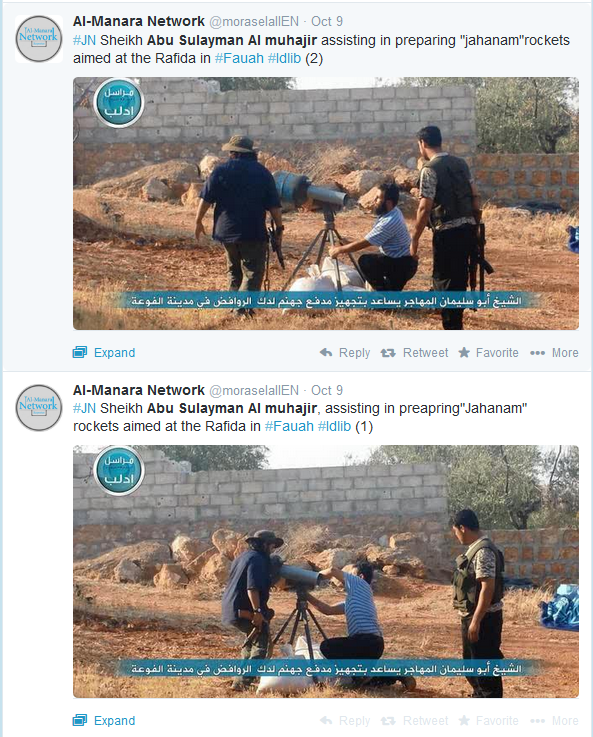
On 9 October another two photos were released, purportedly showing Abu Sulayman helping al-Nusra fighters prepare rockets. However this time the photos were claimed to show him fighting not against ISIS but against Syrian government forces.

SulaymanTweetScreenshots

From that point, he remained mostly quiet, aside from occasional Twitter comments until his account was shut down. But now he’s appearing on al-Jazeera, and becoming forthright again in his criticism of both ISIS and the West and defending al-Nusra/al-Qaeda’s view of the Syrian conflict.

Watch this space.

Online radicalisation: how much does it matter?

Today, the Attorney-General George Brandis announced that “the Australian Government is providing nearly $18 million to combat the lies and propaganda terrorist groups are promulgating online to gain support and sympathy from vulnerable young Australians.”

Neil Gaughan, Australia’s top counter-terrorism officer in the Federal Police, spoke to the Sydney Morning Herald about people joining jihadist groups in Syria, and said that “we’re seeing more people go who are, I suppose, cleanskins, that aren’t on anyone’s radar. They’re self-radicalising and deciding to go overseas… We’re seeing young boys radicalised really quickly online and just going.”

These statements interested me because terrorism researchers, including myself, have tended to argue that such fears are overstated.

Governments across the world are highly concerned about people becoming involved in terrorism through online activity. There is a big fear that individuals who weren’t on any intelligence radar will self-radicalise, via the internet, and quickly become willing to engage in violence. However, academic publications often argue that this fear is not well-founded, and that online self-radicalisation rarely happens.

An earlier post, Has online jihadist radicalisation been overhyped? gave several examples of such research. Studies published since then continue to make that argument.

For example, this 2013 Rand report Radicalisation in the digital era: The use of the internet in 15 cases of terrorism and extremism reviewed 150 academic articles on “online radicalisation”, and examined 15 case studies, concluding:

Our research supports the suggestion that the internet may enhance opportunities to become radicalised and provide a greater opportunity than offline interactions to confirm existing beliefs. However, our evidence does not necessarily support the suggestion that the internet accelerates radicalisation or replaces the need for individuals to meet in person during their radicalisation process. Finally, we didn’t find any supporting evidence for the concept of self-radicalisation through the internet.

Similarly, social media is often portrayed as playing a decisive role in luring people to join jihadist groups in Syria. But so far, research suggests that it’s role is overstated.

There is this forthcoming report on foreign fighters from the UK:

The report by the International Centre for the Study of Radicalisation and Political Science (ICSR) – due to be published in the next few weeks – will conclude that the role of the internet and social media is often exaggerated.

Instead, real-world social networks, friendships and small group dynamics are the decisive influence in radicalising young British Muslim men and making them go to Syria, researchers will say.

This CTC Sentinel article on foreign fighters from Germany:

The study also provides additional insight into the radicalization process. Of the individuals assessed, 72 percent had some connection to the Salafist scene from the beginning of the radicalization process. The internet as a sole impetus of radicalization was present in only 13 cases. This data indicate that social contacts are a major factor when it comes to the path of radicalization. The percentage of people for whom offline social contacts played no role fell to 3 percent.[38] The study concludes that the “self-radicalization by internet” hypothesis is undermined by the results. In fact, people who were influenced by the internet were more likely to propagate Salafism publically or were noticed by security services.[39]

The study also contains information on the duration of the radicalization process for 128 persons. Less than half (42 percent) radicalized within 12 months. In only 12 cases do we see three months or fewer between radicalization and traveling to Syria. However, while the majority of cases exceeded 12 months, the average has fallen from 3.3 years to 1.2 years since the war in Syria started. The percentage of those who have been radicalized within a year prior to their leaving has risen from 25 to 50 percent.[40] The internet had no apparent influence on the speed of the radicalization process.[41]

This speech by Sidney Jones on foreign fighter from Indonesia, which would be based on research by IPAC:

Despite ISIS’ sophisticated propaganda campaign on social media, most Indonesians who have joined appear to have had existing links to radical groups or were friends with those who did—they were not ‘self-radicalized’ through the Internet. This has not been for lack of enthusiasm in the broader Muslim activist community, but probably has more to do with the fact that established groups have the networks to facilitate travel.

So what explains the gap between academic and practitioner perceptions? A few possibilities are:

1. The academics are wrong. Perhaps, lacking access to the information intelligence services have, academics don’t see the many cases of online self-radicalisation occurring and just assume it’s not happening. Or the academics are relying so much on past incidents, which are easier to research, that they aren’t seeing a substantive shift that has occurred more recently. Or academics are so committed to debunking what they perceive to be conventional wisdom, they don’t give the other side a fair hearing.

2. The security officials are wrong. Perhaps, focused on pressing cases, they don’t get the time to look holistically, weigh up the different factors involved in various incidents, and question their own assumptions. Or they tend to see engagement with online extremist material as sufficient evidence of a terrorist threat in itself (such as in the UK where people are jailed for downloading Inspire magazine, regardless of any intent to to act).

3. Both are right, and it is just a difference in emphasis. Perhaps academics are right that online activity rarely radicalises people to the point of terrorism by itself, so cases of “self-radicalisation” are rare, but police are greatly concerned about those rare cases because they are so much harder to identify and prevent.

I don’t have an answer, this is something I’m looking forward to doing some research on in the future.

Instead of an answer, I will leave you with these talks by Maura Conway and Thomas Hegghammer, about the limits of current research into the role of online activity in terrorism.

Good riddance to 2014

2014 has not been a good year in the areas I blog about.

This post looks back at some of my writing and lists five reasons why it’s been a bad year for Australia in terms of terrorism and human rights. It ends with some suggested organisations to donate to, for anyone feeling the same way.


  1. The Sydney siege.

With regard to this blog’s main theme (terrorism in Australia) the biggest development has been the horror of the Sydney siege, which ended with the deaths of two hostages.

There is some debate over whether it should be considered a terrorist incident, given that the gunman Man Haron Monis was acting alone and that there was a mix of motivating factors, including mental health issues, attention-seeking, and his losing battle with the justice system over sexual assault and murder. Terrorism is a very subjective term, so I’ll briefly explain my reasons for including it here as a terrorist incident.

First, because it was an act of serious violence aimed at impacting a wider audience than the immediate targets (the hostages).

Second, because there are many indications of political motivation:

  • The demand that the police provide him with an Islamic State flag.
  • The attempts to contact the Prime Minister during the siege.
  • The gunman’s insistence that the hostages call him an IS member and claim the attack in IS’s name.
  • His pledge of allegiance to IS on his website before the attack.
  • His public postings of enthusiasm for IS and other Sunni jihadists for about a month before the attack.
  • His attendance at rallies and political events, including a Hizb ut-Tahrir rally, where he told a journalist that “I believe a speech is not enough. We have to do something.”
  • His history of politically-motivated crime, back when he was a Shia, which included sending offensive letters to the families of Australian Defence Force members and terror victims.

That doesn’t mean that a terrorism paradigm completely explains his actions, or that the political response should be framed primarily in counter-terrorism terms rather than addressing mental health or misogynist violence. Defining this as a terrorist incident does not mean that it was only a terrorist incident and that other factors didn’t play a huge role.

The point is that the other factors don’t rule out the political motivation, and therefore terrorist aspect, of the crime.

There was a recent Blogs of War: Covert Contact podcast episode on the false dichotomies used in public discussion of these sorts of events. Ie: was he mentally ill or a terrorist? Was it personal or criminal or political or religious etc? The categories aren’t mutually exclusive, and mixed motivations are common to human behavior. An act can still count as terrorism if the person is deranged and acts alone.

In fact it’s not that unusual. Research by Paul Gill and Emily Corner found that mental illness was quite common among lone-actor terrorists. Ramon Spaaij’s book on lone-actor terrorists found that they often had an idiosyncratic mix of motivations, often including mental health problems and personal grievances along with ideology.

Admittedly his political motivation is less clear-cut than, for example, Brievik. However, he also clearly has more political motivation than Martin Bryant did. He’s on the borderline, and just hits the threshold of being a terrorist.

For some alternative views, arguing against calling the Sydney Siege a terrorist incident, see these pieces by Anne Aly, James Brown, @EX_V19 and Clarke Jones.

To me, it’s the second fatal terrorist attack in Australia this century, the first being this anti-abortion attack in 2001.

For an article placing this attack in the context of similar recent attacks by unstable individuals taking up IS’s call to arms, see The Islamic State’s Irregulars by J.M. Berger.


  1. The increased jihadist threat.

Most of my published writing has been on the threat of jihadist terrorism in Australia, and it’s something I’ve become increasingly pessimistic about. At the end of 2012 I wrote a threepart piece on the state of Australian jihadism, and while it noted the transformative potential of the Syria mobilisation, it didn’t conclude that the threat was growing:

However, it does not follow that Australian jihadist activity is rising. Risa Brooks has shown how US analysts drew poorly-founded conclusions from a perceived spike in US jihadism in 2009. Clint Watts has written several posts on the problems of identifying trends in year-by-year measurements of low-frequency events like jihadist plots.

My view is while Australian jihadism is definitely at a lower level than during 2003-2005, it remains persistent and the Syria conflict in particular has created the potential for growth.

We will have to wait and see the impact the events in Syria have. Overall, we are still dealing with a very small, low-tech, interlinked and closely-monitored (though possibly more diffuse) extremist fringe. 2012 has simply delivered a few new angles to watch.

By November 2013, it became clearer that the Syria mobilisation was having a large impact, but not necessarily that things were dramatically worsening:

The Syrian conflict is having an impact well beyond its borders, by drawing in neighboring countries like Turkey and Lebanon, becoming a magnet for jihadists around the world, and exacerbating sectarian tensions. For Australia, this has resulted in a foreign fighter mobilization on a scale not previously seen, sparked sectarian violence in Sydney and Melbourne, and provided a cause that could expand the country’s traditionally small jihadist scene. This has been a dramatic development for jihadist activity in Australia, and therefore poses a key concern for security agencies.

The actual extent of the threat, however, remains unclear. For example, local sectarian violence has recently declined despite continuing tensions. The most serious threat posed is that some returning fighters will have the intention, and increased capability, to attack Australia. This possibility, however, depends on the numbers of people actually fighting, the groups with which they are fighting, and to who else they may be connected. Reliable information on these details is currently limited. What is clear is that the Syria mobilization could radically reshape jihadist activity in Australia, a security concern that needs to be closely monitored.

But by late 2014, the outlook was far bleaker:

Australia’s jihadist foreign fighters pose an ongoing and increasingly complex national security threat. Australians have continued to join jihadist groups in Syria and Iraq, with many joining ISIL. Some of the fighters have been involved in war crimes, some have made explicit threats against Australia, some have played leadership roles, and some have returned to Australia. Evidence has also emerged of active recruitment networks, connections to earlier terrorist plots, and of violent plans within Australia.

At the same time, the threat has become a greater political priority, resulting in escalating countermeasures, extra resources to security agencies, and attempts at legislative changes. Several of the proposed legislative changes, however, are highly contentious and might complicate counterterrorism efforts. The continuing foreign fighter problem has prompted a high-level response, but elements of the response pose their own problems. On the whole, the situation has substantially worsened during the past year.

From following open-source information on Australian jihadism for the past few years, the threat has clearly grown. This is why I don’t share the view that ASIO’s raising of the threat level was a political stunt.


  1. The government’s response.

However, as the conclusion quoted above shows, the problem is not only the increased threat but the response to it.

Australia had a chance early this year to address many of the widely-known problems with the counter-terrorism legislation rushed through parliament after 9/11, and to update it in light of technological changes and an evolving threat. Several independent reviews had come out in 2012 and 2013 from the Independent National Security Legislation Monitor (INSLM), the Council of Australian Governments (COAG), and the Parliamentary Joint Committee on Intelligence and Security (PJCIS).

The reviews made a strong case for change, but also pointed out (particularly the PJCIS report) that change should be made slowly, cautiously, and with extensive consultation, to make sure we get the laws right.

However, for the first half of this year, these reviews were ignored by the Abbott Government (just as they had been by the Gillard and Rudd governments). In early 2014, I wrote that:

This is really unfortunate. These are extremely valuable reports, and where they have made recommendations to remove existing powers they have also provided detailed arguments that doing so will not harm national security, which at the very least deserve a similarly detailed response and not just assertions of ‘national security’ back.

Moreover, most of the recommendations were actually about more mundane issues, such as that some of Australia’s counter-terrorism legislation is so poorly-worded as to make it unusable, or that some bits leaves dangerous gaps.

Then around mid-way through the year, the government did respond, but not in a good way. First, it tried to abolish one of Australia’s most valuable oversight mechanisms, the INSLM (fortunately it backtracked).

Then, the government rushed extensive new national security legislation through Parliament with little time for public submissions, creating a whole range of new infringements on liberties, and some laws that may turn out to be as unworkable as some of the older ones.

There are plenty of critiques of these new laws around, of varying quality. The strongest come from the Gilbert and Tobin Centre for Public Law. See here, here and here.


  1. The anti-Muslim backlash.

Following the counter-terrorism raids in early September (as part of Operation Appleby, which has so far resulted in eleven people being charged, some with terrorism offences), Australia has seen a wave of harassment, sometimes violence, towards Muslims.

This has included assaults, death threats, graffiti, and property damage. There’s no shortage of incidents, but that doesn’t stop columnists from pretending they aren’t happening, referring to an “imaginary backlash” and “theoretical victims“.

It mirrors the way some leftists and civil libertarians dismiss the terror threat and respond sarcastically to every arrest and every announcement. The difference is that the jihadist threat is already taken very seriously by the bulk of the media, but Islamophobia is not.


  1. The treatment of asylum seekers and refugees.

One issue I use to write about was how Australia placed certified refugees in indefinite detention if they failed ASIO security assessments. This is still happening today, and it remains a horrendous and unnecessary policy, leading to “extraordinary rates of depression, anxiety and self-harm, including one man repeatedly beating his head with a toilet door.” One of them has killed himself, and a quarter of them have attempted or threatened suicide.

When I first wrote on this, these 50-odd adversely-assessed refugees were among the only people Australia was detaining indefinitely. I honestly thought there were strong prospects for change, given High Court rulings and dissent within both major parties.

Instead, we’ve gone backwards again. These adversely assessed refugees remain stuck, and now many more asylum seekers are receiving the same treatment. In 2013 the Gillard government introduced “No Advantage”, and then we saw Rudd’s “PNG Solution”, followed by Abbott’s “Operation Sovereign Borders”. The result is that Australia is in effect holding thousands of asylum seekers in indefinite detention (as their refugee claims are not being assessed).

We are inflicting a mental health crisis on them. People have been raped and murdered in our detention centres.

I haven’t written on this issue in ages. It seems so self-evidently wrong that arguments shouldn’t be necessary. I’ve disengaged entirely. I’m not proud of it, and greatly admire those who continue to fight against these policies.


So, for all those reasons, it wasn’t a great year.

I’m ending it by making some donations, hoping it will help make 2015 a slightly better year for some. Links are provided below if you would like to donate too.

  • Donate to the World Food Programme’s Syria Emergency Appeal here.
  • Donate to the Society for Mental Health Research Fund here.
  • Donate to the Refugee Council of Australia here.

Three new articles

Here are three articles I’ve had published recently. The newest is this article in the journal Democracy and Security, co-authored with Shandon Harris-Hogan:

Mantiqi IV: al-Qaeda’s failed co-optation of a Jemaah Islamiyah support network.

On July 14, 2000, a man called the Perth office of the Australian Security Intelligence Organisation (ASIO) and stated, “I’ve just returned from Afghanistan, I’ve just met with Osama bin Laden … I would like to have an interview with an ASIO officer … I would be willing to work for ASIO should the need arise.”1 The man was a member of Jemaah Islamiyah (JI), a group that would gain the reputation as Southeast Asia’s deadliest terrorist organization following the 2002 Bali bombings. He had been sent to Afghanistan by the leaders of Mantiqi IV, JI’s Australian branch, where he was trained and tasked by al-Qaeda to assist an attack timed to occur during the 2000 Sydney Olympics. If successful, this plot would have constituted the first al-Qaeda-directed act of terrorism within a Western country and the first act of jihadist violence conducted on Australian soil.

The plot’s origins were not unique. Al-Qaeda’s strategy has long involved co-opting other jihadist organizations and redirecting their focus toward Western targets, often making use of their Western-based support networks. Al-Qaeda utilized UK-based support networks of Pakistani jihadist groups for attacks such as the 7/7 London bombings.2 Yet unlike London, this early Australian plot did not result in mass casualty violence. Instead, as the voluntary phone call to ASIO demonstrated, the plot fell apart. It is hoped that a detailed examination of this planned attack will help to identify factors that both enable and hinder al-Qaeda’s ability to attack the West through co-opting existing jihadist groups and their external support networks.

This article draws on interviews with former members of Mantiqi IV, court material, media sources, and existing scholarly accounts of al-Qaeda and JI to assess the factors that shaped the outcome of this plot. The first section outlines a number of key concepts such as jihadist movements, external support networks, and al-Qaeda’s strategy of co-optation. The article then provides a historical account of Jemaah Islamiyah’s emergence in Southeast Asia and the antecedents of its external support network in Australia. This is done in order to demonstrate the characteristics that made JI susceptible to co-optation by al-Qaeda, as well as those factors that would later prove to be obstacles. This is followed by an examination of Mantiqi IV and of al-Qaeda’s attempt to co-opt JI for its global war against the United States and its allies. The final section examines how this co-optation process played out among Mantiqi IV’s members and the resulting terrorist plot within Australia………


I also have a new post out in The Strategist:

In defence of ASIO’s passport powers.

The Australian Security Intelligence Organisation often cancels the passports of suspected terrorists, and has increasingly done so to prevent Australians joining jihadist groups in Syria and Iraq. ASIO has issued adverse security assessments for more than 100 passports since 9/11, with over 60 cancellations in the past two years alone.

This tactic has occasionally been criticised on civil libertarian grounds, but has recently faced criticism from a different direction. Some commentators have argued that passport confiscations keep dangerous terrorists in Australia, and that it’d be better to let them leave and work to ensure they never return.

However, that approach would create bigger problems…….


And a couple of weeks ago I had short piece published in the Alternative Law Journal:

National security law update

Australian citizens continue to join proscribed terrorist organisations in Syria and Iraq. This has gone from being a neglected security concern to becoming the Australian government’s ‘number one national security priority’.

The result is that three sets of new national security legislation are being introduced in quick succession, which carries great risks for human rights and effective counter-terrorism…….

However that last one is a bit out of date, as it was written a while ago. The laws it discusses have now been passed, and there have also been amendments. For example, I wrote that the no-go-zone proposal “could require any Australian returning from Syria and Iraq to prove they were not involved in terrorism”, but now there’s been a PJCIS amendment so that the law can’t apply to entire countries. Currently the law applies to al-Raqqa province in Syria.

On Raff Pantucci’s paper: A Death in Woolwich

Raffaello Pantucci has a new article out in the RUSI Journal (open access):

A Death in Woolwich: The Lone-Actor Terrorist Threat in the UK

It’s partly about the Lee Rigby murder, but also about the difficulties of addressing the UK’s changing terror threat:

From a security perspective, it is clear that lone-actor plots are, by their very individualised nature, those that are harder to penetrate, detect and disrupt. Fortunately for the security services, these individual cases are rare, and the majority of those who are drawn to extremist ideologies prefer to fight abroad or, if plotting at home, to become involved in complicated networked plots that security services are more easily able to penetrate and disrupt.

The case of Michael Adebolajo and Michael Adebowale, however, presents a new concern, hinting at a fusion of a long term radical community and the lone actor approach. Previously, most of the individuals who had been involved with Al-Muhajiroun had gone on to attempt to fight and train abroad, or set up networks to try to carry out complicated plots. The concept of lone-actor terrorism had not clearly entered their activity flow. Should the actions of Adebolajo and Adebowale prove to be the beginning of a trend, the security services will suddenly find their caseload multiplying as they try to work out who, within their broader intelligence networks, might be moving towards launching an attack similar to the murder of Lee Rigby and, once identified, how they can be detained, if their actions at that point are restricted to the usual digest of extremist activity associated with the group. It is worth noting that, almost two years on, there has not been a repeat of the Woolwich incident, though a number of individuals within the wider network have been arrested on various charges, including some related to terrorist activity. There could be many reasons for this lull, and given the longevity and persistence of the ideology and group it is impossible to discount a repeat or an imitation as yet.

Yet overreacting may prove equally counterproductive. Repeated arrests and intimidation through legal means may cause frustration and lead to extreme reactions. This appears to have already happened in some cases, but it is far from a universal reaction, and often long term activists remain just that, continuing to show up at protests without ever transitioning to terrorist violence. These individuals may present a problem because they help an ultimately violent ideology to persist and spread, but if they stay on the right side of the line of legality then they remain within their rights to express these views, as unpalatable and unpleasant as they may be.

The article is relevant to Australia’s situation, even though we face a much smaller threat than the UK does. The dilemmas he describes are common to security services in liberal democracies, and three recent incidents suggest Australia’s jihadist threat is evolving in a similar way to the UK’s.

In Melbourne, two police officers were stabbed by a suspected Islamic State (IS) supporter whose passport had been confiscated by ASIO.

In Sydney, an alleged terror plot was uncovered that involved members of a suspected IS support network, several of whom had also had their passports confiscated. Police claim senior Australian IS recruiter Mohammad Ali Baryalei ordered conspirators in Australia to kidnap and murder a randomly chosen non-Muslim member of the Australian public, film the killing, and place the video on social media.

In Brisbane, a man named Agim Kruezi was charged over a separate alleged terror plot. He had already been arrested for allegedly recruiting people for IS, but further investigations led to new charges including transportation of a firearm in preparation for a terrorist act, and possessing machetes, knives, balaclavas, military fatigues and fuel in preparation for a terrorist act.

Much about these incidents remains unproven, and we will have to see what comes out in court. However, so far these incidents suggest a shift away from the sorts of large-scale plots (involving many participants and developing over a long period of time) that were foiled by operations Pendennis and Neath, towards smaller scale attempts at violence involving fewer people and less sophisticated methods.This apparent shift is consistent with the two recent attacks in Canada, and IS’s repeated calls for ad-hoc attacks in the countries taking part in military action against it:

If you can kill a disbelieving American or European – especially the spiteful and filthy French – or an Australian, or a Canadian, or any other disbeliever from the disbelievers waging war, including the citizens of the countries that entered into a coalition against the Islamic State, then rely upon Allah, and kill him in any manner or way however it may be…. Do not ask for anyone’s advice and do not seek anyone’s verdict.

I’ve previously argued for scepticism towards the idea that ad-hoc attacks represent the future of jihadism, but with IS’s leadership explicitly adopting this approach, these type of attacks will likely be prominent for at least the next couple of years. Australia will likely see more of these increasingly unpredictable (but hopefully low-impact) plots, and security services will be continually called on to take action.

Raffaello Pantucci’s article does a great job explaining this evolving threat and the counter-terrorism dilemmas it creates.