Fred Halliday on the Iraq war’s legacy

I’m re-reading a lot of Fred Halliday’s work (Middle East scholar at LSE until his death in 2010), mainly his collection of openDemocracy essays. One part in this 2007 essay really struck me, when he outlined some long-term consequences from the 2003 invasion of Iraq.

It has already set in train six major processes, which will take years to work themselves through:

  1. the wholesale discrediting of the US, its allies, particularly Britain, and any campaign for the promotion of democracy in the Arab world
  2. the unleashing across the middle east, and more broadly within the Muslim world, of a revitalised militant Islamism, inspired if not organised by al-Qaida, which has used the Iraq war greatly to strengthen and internationalise its appeal
  3. the shattering of the power and authority of the Iraqi state, built by the British and later hardened by the Ba’athists and the fragmentation of Iraq into separate, antagonistic, ethnic and religious zones
  4. the explosion, for the first time in modern history, of internecine war between Sunni and Shi’a in Iraq, a trend that reverberates in other states of mixed confessional composition
  5. the alienation of all sectors of Turkish politics from the west and the stimulation of an authoritarian nationalism there of a kind not seen since the 1920s
  6. the fomenting, albeit in slow motion and with some constraints, of a new regional rivalry, between two groupings: Iran and its allies (including Syria, Hizbollah and Hamas), versus Saudi Arabia, Egypt and Jordan – a rivalry made all the more ominous and contagious by Iran’s pursuit of nuclear weapons.

Sadly, this stands up well today.

Resources: social science and the “Islamic State” threat

Amid all the post-Paris punditry, there’s been some excellent articles lamenting the state of political discussion on the “Islamic State” (IS) threat. Richard Cooke showed how familiar political narratives can’t easily explain this obscene violence. Osman Faruqi wrote this mainly Australia-focused piece, “Everyone’s wrong and no one knows what to do (including me)“, despairing at poorly founded solutions proposed ultra-confidently by commentators from both left and right. Similarly, Adam Elkus wrote this mainly America-focused piece on the superficial strategies proposed by both hawks and doves.

I share the despair expressed in these pieces, and propose no solution myself. Identifying bad ideas, such as shutting out refugees, is much harder than coming up with good ones.

However social science can, and should, help the wider societal effort to figure out what to do. Within academia, engagement with national security issues often remains controversial (with reason), and is relatively rare in Australia compared to the United States. But I’m firmly of the view that it’s both extremely valuable and that there’s a strong ethical imperative for it:

Social science has an implied social contract with society: In exchange for the privileges and freedoms of academic life, social science agrees to help solve problems that concern society.

And IS is, to put it mildly, a problem that concerns society. So this post provides some resources introducing what social science has to say about the IS threat.

It builds on the previous post, but with a more academic focus. The resources are all open-access.


The first place to start is these Monkey Cage posts on what social science can tell us about the Paris attacks, and what social science can tell us about IS.

These edited collections from the past two years help explain the background of IS and the broader Syrian conflict. They are particularly valuable for demystifying IS, comparing it to other insurgencies rather than treating it as something unprecedented:

The political science of Syria’s war, Project on Middle East Political Science, 19 December 2013.

Syria and the Islamic State, Project on Middle East Political Science, 1 October 2014.

Special issue on the Islamic State, Perspectives on Terrorism, August 2015.


These are some good short pieces on the “is IS Islamic?” debate:

How ISIS uses and abuses Islam, Vox, 18 November 2015.

Does ISIS really have nothing to do with Islam? Islamic apologetics carry serious risks, Washington Post, 18 November 2015.

The endless recurrence of the clash of civilizations, Monkey Cage, 20 November 2015.

ISIS, the clash of civilizations and the problem of apologetics, Medium @Aelkus, 20 November 2015.

Why it does not matter whether ISIS is Islamic, Medium @Aelkus, 20 November 2015.


These reports outline research on Countering Violent Extremism (non-coercive efforts to prevent people from becoming involved in terrorism), which is one part of the response to IS:

Does CVE work? Lessons learned from the global effort to counter violent extremism, Global Center on Cooperative Security, September 2015.

Countering violent extremism: developing an evidence-base for policy and practice, Hedayah, September 2015.

Resources: background information for the Paris attacks

The terrorist attacks in Paris have killed over a hundred people. It will probably be a while before it becomes clear who carried out these murders and how they evaded the security services. In the meantime, this post provides sources of background information to help make sense of the attacks.


On this style of urban siege terrorism:

John P. Sullivan and Adam Elkus, Urban siege in South Asia, Open Democracy, 9 November 2009.

Daveed Gartenstein-Ross and Daniel Trombly, The tactical and strategic use of small arms by terrorists, Foundation for Defense of Democracies, October 2012.

David Kilcullen, Westgate mall attacks: urban areas are the battleground of the 21st century, The Guardian, 28 September 2013.

John P. Sullivan and Adam Elkus, Urban siege in Paris: a spectrum of armed assault, Small Wars Journal, 2 February 2015.


On French counter-terrorism:

Charles Rault, The French approach to counterterrorism, Combating Terrorism Center Sentinel, 13 January 2010.

Pascale Combelles Siegel, French counterterrorism in the wake of Mohammed Merah’s attack, Combating Terrorism Center Sentinel, 23 April 2012.

Frank Foley, Charlie Hebdo attack: is France’s counter-terrorism model still the example to follow?, The Telegraph, 13 January 2015.

Joshua Keating, No one in Europe is tougher on terror than France. That didn’t stop the attacks, Slate, 13 January 2015.


On the ability of IS and al-Qaeda to launch attacks within Western countries:

Clint Watts, Inspired, networked and directed – the muddled jihad of ISIS & al Qaeda post Charlie Hebdo, War On The Rocks, 12 January 2015.

Thomas Hegghammer and Petter Nesser, Assessing the Islamic State’s commitment to attacking the West, Perspectives on Terrorism, August 2015.

Syria update and new articles

The most recent Senate Estimates hearings have given us the latest official figures on Australians involved with jihadist groups in Syria and Iraq.

These are:

  • 120 Australians are currently fighting or are engaged with terrorist groups in Syria and Iraq.
  • At  least  32  and  potentially  up  to  42  Australians  are  believed to  have potentially  been  killed  in  the  conflict  to  date.
  • Approximately  30  Australians  have  returned  from  the  conflict.
  • About  170  people  in  Australia  are  providing  support  to  individuals  and  groups  in  the  Syria  and  Iraq  conflicts through  financing  and  recruitment,  or  are  seeking  to  travel.

(these are direct quotes, from page 121 of this transcript)

The figure of 120 currently over there has been static for months, as has the figure of 30 having returned. But the figure of up to 42 deaths is higher than previously reported. My own count based on public sources is only 27, and it includes a few doubtful ones. So there’s likely far more going on than we can see.

Meanwhile, I’ve had two new articles out. One is this Strategist Post on the Parramatta shooting and counter-terrorism in democracies. Since then, two of the suspects mentioned in it have been charged. The other is this Eureka Street article on the dangers of using schools to address extremism.

Resources: research on Countering Violent Extremism in Australia

Kevin Dunn, Rosalie Atie, Virginia Mapedzahama, Mehmet Ozalp and Adem F. Aydogan, The Resilience and Ordinariness of Australian Muslims: Attitudes and experiences of Muslims Report, Western Sydney University and Islamic Sciences and Research Academy Australia, November 2015.

Shandon Harris-Hogan, Kate Barrelle, and Andrew Zammit “What is countering violent extremism? Exploring CVE policy and practice in Australia“, Behavioral Sciences of Terrorism and Political Aggression, published online 5 November 2015 (gated).

Anne Aly and Kosta Lucas, “Countering Online Violent Extremism in Australia: Research and Preliminary Findings” in Countering Violent Extremism: Developing an Evidence-Base for Policy and Practice, Hedayah and Curtin University, September 2015, scroll to page 81.

Many authors, “Special Issue: Countering Violent Extremism: Reorienting the Field“, Journal of Policing, Intelligence and Counter Terrorism, Volume 10, Issue 1, 2015 (gated).

Andrew Zammit, Australian Foreign Fighters: Risks and Responses, Lowy Institute for International Policy, 16 April 2015.

Cat Barker, Australian Government Measures to Counter Violent Extremism: a Quick Guide, Australian Parliamentary Library, 10 February 2015.

Kevin Mark Dunn, Rosalie Atie, Michael Kennedy, Jan A. Ali, John O’Reilly and Lindsay Rogerson, “Can you use Community Policing for Counter Terrorism? Evidence from NSW, Australia“, Police Practice and Research: An International Journal, online version published 12 March 2015 (gated).

Kristina Murphy, Adrian Cherney, and Julie Barkworth, Avoiding Community Backlash in the Fight Against Terrorism: Research Report. Australian Research Council (Grant No. DP130100392) March 2015 (gated).

Michele Grossman, “Disenchantments: Counterterror Narratives and Conviviality,” Critical Studies on Terrorism, Volume 7, Issue 3, 2014 (gated).

Roslyn Richardson, Fighting Fire with Fire: Target Audience Responses to Online Anti-Violence Campaigns, Australian Strategic Policy Institute, 4 June 2014.

Shahram Akbarzadeh, “Investing in Mentoring and Educational Initiatives: The Limits of De-Radicalisation Programmes in Australia“, Journal of Muslim Minority Affairs, Volume 33, Issue 4, 2013.

Michele Grossman and Hussein Tahiri, Community and Radicalisation: An Examination of Perceptions, Ideas, Beliefs and Solutions Throughout Australia, Victoria Police with Victoria University, September 2013.

Robyn Broadbent, “Using Grass Roots Community Programs as an Anti-Extremism Strategy“, Australian Journal of Adult Learning, Volume 53, Issue 2, July 2013 (gated).

Anne Aly, “The Policy Response to Home-Grown Terrorism: Reconceptualising Prevent and Resilience as Collective Resistance“, Journal of Policing, Intelligence and Counter Terrorism, Volume 8, Issue 1, 2013.

Basia Spalek and Alia Imtoual, “Muslim Communities and Counter-Terror Responses: “Hard” Approaches to Community Engagement in the UK and Australia“, Journal of Muslim Minority Affairs, Volume 27, Issue 2, 2007 (gated).


Update 1: Added the Australian Journal of Adult Learning, Behavioral Sciences of Terrorism and Political Aggression and the Western Sydney University articles on 8 december 2015.

Terrorist-spotting

Back in 2013 and 2014, I had some involvement with this radicalisation information booklet. The Attorney-General’s Department (AGD) had ultimate editorial control, but it was delivered under contract from Monash, and involved consultations with people from other institutions and some community groups. It was not intended as some sort of spot-the-terrorists guide. Then, this week it was released by the government as part of an extremely worrying announcement that teachers would be encouraged to identify whether students are potential terrorists.

Which was a big surprise.

I’m planning to write about this sometime soon, but not sure when, so this is just a post to flag it. I plan to discuss two issues:

1. Why this apparent idea of encouraging teachers to try to spot early-warning signs of terrorism is a terrible idea. There’s a real risk of Australia going down the UK path and that’s very dangerous. Australian counter-terrorism policy has been heading in a bad direction for some time, and this would likely make things even worse.

2. The big questions this whole thing raises about academic involvement with government initiatives. As readers will know, I’m not opposed at all to engagement between academia and government in the national security space. From 2010 to 2013 I was employed in an ARC Linkage Project at Monash that included AFP, VicPol, Vic DPC and Vic DoJ as partners, a period of my life I’m extremely proud of. Engagement does pose dilemmas (see some interesting discussions here, here, here and here) but can benefit society enormously. However, it’s important to be clear-eyed about the risks involved. With this AGD booklet project, I wasn’t.

More on all this later.


Update 1: I made some changes to this post on 4 October 2015. I initially wrote that the AGD “consulted with several of us at Monash”, but it turns out that wasn’t an accurate description so I’ve rephrased it. I also initially wrote that my involvement was in 2013, but realised that a community consultation I participated in actually happened in 2014, so I had some involvement in both 2013 and 2014. Also in the last sentence of the first paragraph I changed plan to announcement, as what the government announced through the Daily Telegraph is not necessarily the government’s actual plan (judging from media releases and official statements), which is another thing I want to look at in the first piece I’m writing.

A few readers have been asking when the articles are coming out. The first one should hopefully be done soon. The second article will take quite a bit longer, it’s going in some interesting directions, including looking back at academic-government engagement in the Vietnam War and even back to World War Two, and becoming a bigger task than planned. In short: first article shouldn’t take much longer, second one will.

Update 2: The first article is now published.

Australians charged under Joint Counter-Terrorism Team operations since 2013

Operation Kirtling (New South Wales)
No charges

Operation Rathlin (New South Wales)
Hamdi Alqudsi: foreign incursions offences found guilty
Amin Iman Mohamed: foreign incursions offences found guilty

Operation Appleby (New South Wales)
Omarjan Azari: terrorism offences (funding) pleaded guilty, terrorism offence (conspiracy to prepare) found guilty
Ali Al-Talebi: terrorism offences (funding) found guilty
Unnamed 24-year old: weapons offences pleaded guilty
Unnamed: drug offences pleaded guilty
Unnamed: weapons offences pleaded guilty
Mohammad Ali Barylei: arrest warrant issued
Unnamed 15-year old: terrorism offence (conspiracy to prepare) pleaded guilty
Ibrahim Ghazzawy: terrorism offence (conspiracy to prepare) now dropped, terrorism offence (making a document) pleaded guilty
Suleyman Khalid: terrorism offence (possession of documents) and later another terrorism offence (conspiracy to prepare), pleaded guilty
Maywand Osman: terrorism offence (conspiracy to prepare) now dropped
Jibril Al Maouie: weapons offences and later a terrorism offence (conspiracy to prepare) pleaded guilty
Mohamed Al Maouie: terrorism offence (preparation) now dropped, terrorism offence (making a document) pleaded guilty
Ahmed Saiyer Naizmand: terrorism offence (control order breach)
Farhad Said: terrorism offence (preparation) now dropped, terrorism offence (making a document) pleaded guilty

Operation Bolton (Queensland)
Agim Kruezi: terrorism offences (preparation) pleaded guilty, foreign incursions offences, pleaded guilty
Omar Succerieh: terrorism offences (funding) now dropped, foreign incursions offences pleaded guilty
Unnamed 32-year old: proceeds of crime offences now dropped

Operation Duntulm (New South Wales)
Fatima Elomar: foreign incursions offences pleaded guilty
Omar Ammouche: weapons offences pleaded guilty
Wissam Haddad: weapons offences pleaded guilty

Operation Hohensalzburg (Victoria)
Hassan el Sabsabi: terrorism offences (funding) now dropped, foreign incursions offences pleaded guilty

Operation Castrum (New South Wales)
Mohammad Kiad: terrorism offences (preparation) pleaded guilty
Omar Al-Kutobi: terrorism offences (preparation) pleaded guilty

Operation Rising (Victoria)
Sevdet Ramdan Besim: terrorism offences (conspiracy to prepare) pleaded guilty
Harun Causevic: terrorism offences (conspiracy to prepare) now dropped, weapons offences pleaded guilty
Unnamed 18-year old: weapons offences pleaded guilty

Operation Amberd (Victoria)
Unnamed 17-year old: terrorism offence (preparation) pleaded guilty

Another JCTT Operation (Victoria)
Adam Brookman: foreign incursions offence, terrorism offence (providing support)

Another JCTT Operation (Victoria)
Jamie Williams: foreign incursions offence now dropped

Operation Peqin / Strike Force Fellows  (New South Wales, includes Curtis Cheng murder investigation)
Talal Alameddine: weapons offence pleaded guilty, terrorism offence (conspiracy to prepare, and membership) now dropped, terrorism offence (possessing a thing) pleaded guilty
Raban Alou: terrorism offence (aid, abet, counsel and procure) pleaded guilty, terrorism offence (conspiracy to prepare)pleaded guilty now dropped, firearms offence now dropped
Mustafa Dirani:  organised crime offence (participate in a criminal group), terrorism offence (conspiracy to prepare) found guilty
Milad Atai: terrorism offence (funding), terrorism offence (conspiracy to prepare, and membership) pleaded guilty
Unnamed 16-year old: terrorism offence (funding)
Massod Zakaria: firearms offences
Linda Merhi: terrorism offence (funding)

Operation Chillon (New South Wales)
Alo-Bridget Namoa: terrorism offences (possessing documents and collecting a thing),  questioning offence (failing to answer Crime Commission questions) pleaded guilty, terrorism offences (preparation) found guilty
Sameh Bayda: terrorism offence (collecting documents), terrorism offences (preparation) found guilty

Operation Vianden (New South Wales)
Unnamed 16-year old: terrorism offence (preparation) pleaded guilty

Operation Middleham (Victoria)
Musa Cerantonio: foreign incursions offence pleaded guilty
Shayden Thorne: foreign incursions offence pleaded guilty
Kadir Kaya: foreign incursions offence pleaded guilty
Antonio Grenata: foreign incursions offence pleaded guilty
Paul Dacre: foreign incursions offence pleaded guilty
Murat Kaya: foreign incursions offence pleaded guilty

Operation Sanandres (New South Wales)
Tamim Khaja: terrorism offence (preparation) pleaded guilty

Operation Himeji (New South Wales)
Unnamed 17-year old: terrorism offence (preparation) now dropped, telecommunications offence

Another JCTT operation (New South Wales)
Renas Lelikan: terrorism offence (membership)

Operation Fortaleza (Victoria)
Phillip Galea: terrorism offences (documents and preparation)

Operation Tressider (New South Wales, Minto stabbing)
Ihsas Khan: terrorism offence (committing act), attempted murder

Operation Broughton (New South Wales)
Bourhan Hraichie: terrorism offences (preparation, making and delivering a document) pleaded guilty

Operation Restormel (New South Wales)
Unnamed 16-year old: terrorism offences (preparation and membership)found guilty
Unnamed 16-year old: terrorism offences (preparation and membership) hung jury

Another JCCT operation (New South Wales)
Mehmet Biber: foreign incursions offence pleaded guilty
Unnamed 17-year old: foreign incursions offences
Muhammad Abdul-Karim Musleh: foreign incursions offences pleaded guilty
Amin Elmir: foreign incursions offence pleaded guilty

Another JCTT operation (South Australia)
Unnamed 50-year old: terrorism offences (advocating)

Operation Kastelhem (Victoria)
Abdullah Chaarani: terrorism offence (preparation) found guilty, terrorism offences (acts)
Hamza Abbas: terrorism offence (preparation) found guilty
Ahmed Mohamad: terrorism offence (preparation) found guilty, terrorism offences (acts)
Ibrahim Abbas: terrorism offence (preparation) pleaded guilty
Hatim Moukhaiber: terrorism offence (act)

Operation Marksburg (New South Wales)
Haisem Zahab: foreign incursions offences

Another JCTT operation (South Australia)
Zainab Abdirahman-Khalif: terrorism offence (membership) found guilty

Operation Tematin (Victoria, Brighton siege investigation)
Kane John Dalrymple: firearms offences and others
Unnamed 25-year old: firearms offences and others
Unnamed 47-year old: firearms offences and others
Unnamed 36-year old: firearms offences

Another JCTT operation (New South Wales)
Moudasser Taleb: foreign incursions offences

Operation Rosenborg (New South Wales)
Unnamed 18-year old: firearms and drug offences

Operation Silves (New South Wales)
Khaled Khayat: terrorism offences (preparation)
Mahmoud Khayat: terrorism offences (preparation)
Khaled Merhi: weapons offence

Another JCTT operation (Victoria)
Isa Kocoglu: foreign incursions offence

Operation San Joes (Victoria)
Ali Khalif Shire Ali: terrorism offences (collecting or making documents, preparation)

Another JCTT operation (New South Wales)
Belal Betka: foreign incursions offence
Ahmad Hawchar: proceeds of crime offence
Unnamed 27-year-old: proceeds of crime offence

Another JCTT operation (Victoria)
Momena Shoma: terrorism offence (act) pleaded guilty

Another JCTT operation (New South Wales)
Nowroz Amin: terrorism offence (preparation), foreign incursions offence, customs offence

Another JCTT operation (Queensland)
Zaid Abdus Samad: foreign incursions offence

Another JCTT operation (New South Wales)
Mohamed Nizamdeen: terrorism offence (possessing a document) now dropped

Operation Donabate (Victoria)
Ertunc Eriklioglu: terrorism offence (preparation)
Samed Eriklioglu: terrorism offence (preparation)
Hanifi Halis: terrorism offence (preparation)

Operation Kozjak (Victoria)
Khaled Temssah: foreign incursions offence

Another JCTT operation (New South Wales)
Isaak el Matari: terrorism offences (preparation and membership)
Radwan Dakkak: terrorism offence (membership)
Ahmed Tebya: fraud offences


If I’ve written “unnamed”, this means that:

  1. There has been a suppression order on naming them.
  2. I’m guessing there might be a suppression order and playing it safe.
  3. Their charges are relatively minor and their names had not been widely splashed throughout the media, so I’ve chosen not to name them because I don’t want to increase the likelihood of “terrorism” appearing when their names are googled. They might simply be trying to get on with their lives.

Update 1: On 14 September 2015 I added that Hassan el Sabsabi’s terrorism charges were dropped. He has pleaded guilty to the foreign incursions charges.

Update 2: On 12 October 2015 I added Wissam Haddad to Operation Duntulm.

Update 3: On 11 December 2015 I added the five new Operation Appleby charges, the three Curtis Cheng related charges, and deleted something from the Operation Appleby bit just in case it could be at odds with a suppression order.

Not being a journalist, I don’t get sent the suppression orders. But if I google a fact that was once widely-reported, and find that the fact is no longer mentioned on any Aus news websites, I assume that a suppression order must have been put in place. Here’s an article on how strange suppression orders can be in the internet age.

Update 4: On 22 March 2016 I added the information for the Ahmed Saiyer Naizmand, Alo-Bridget Namoa, Sameh Bayda and Operation Peqin, added the ages of some of the unnamed, and updated information on verdicts. I plan to double-check some of the Operation Appleby information on guilty pleas later, I’m concerned there might be a couple of errors.

Update 5: Added Operation Vianden on 25 April 2016.

Update 6: Added information for Operation Middleham, another JCTT operation, and updated the Curtis Cheng related information, on 17 May 2016. There are several different operations involved in the Curtis Cheng related arrests, so I’m not sure if I’ve grouped them correctly.

Update 7: Added Farhad Said and Murat Kaya on 30 May 2016.

Update 8: Added “Unnamed 17-year old” on 20 June 2016. Also, a lot of these links have gone dead because the AFP have updated their website. I’ve replaced about a third of them so, using the Wayback Machine.

Update 9: Added that Osman’s terror charges were dropped, and that Besim pleaded guilty, on 30 June 20-16. Also I haven’t replaced most of the broken AFP links yet.

Update 10: Added Renas Lelikan’s charge, and updated the outcomes for Hamdi Alqudsi, Mohammad Kiad and Omar Al-Kutobi, on 28 July 2016.

Update 11: Added the Galea one on 9 August 2016. Annoyingly the press releases don’t announce the names of the JCCT operations as much anymore.

Update 12: Added Ihsas Khan and Bourhan Hraichie on 15 September 2016. Also, about two thirds of the links are fixed now. I suggest everyone uses the Wayback Machine when linking to a government website, otherwise the links go dead all the time.

Update 13: On 14 October 2016 I added the two unnamed 16-year olds charged the day before, added that Namoa had pleaded guilty to the questioning offence, and added the operation names for Sanandres, Himeji and Fortaleza.

Update 14: Updated the information for the Omar Succeriah (terrorism charge dropped, pleaded guilty to incursions) on 24 October 2016.

Update 15: Added the information for Mehmet Biber and his co-accused on 3 November 2016.

Update 16: Added Muhammad Abdul-Karim Musleh, and also changed one “Another JCTT Operation” to Operation Broughton, on 28 November 2016. Also lots of the hyperlinks are still messed up.

Update 17: Added Jamie Williams, Massod Zakaria, Amin Elmir, the unnamed “advocating terrorism” man, the Operation Kastelhom charges, and that Al-Talebi was found guilty, on 26 December 2016.

Update 18: Added the preparatory terrorism offences for Operation Chillon (and updated the operation name) on 8 February 2017.

Update 19: Added Haisem Zahab on 5 March 2017.

Update 20: Added Kane John Dalrymple, the 22-year old South Australian, and Adam Brookman, on 10 June 2017. Also added that Azari pleaded guilty to his funding offences, and the States for each operation.

Update 21: Added the 25-year old, charged as part of the Brighton investigation, on 12 June 2017.

Update 22: Added the third Brighton arrest and Moudasser Taleb on 15 June 2017.

Update 23: Added the fourth Brighton arrest, and updated the information on Raban Alou, on 18 June 2017.

Update 24: Added Operation Rosenborg on 1 July 2017.

Update 25: Added Khaled Mahmoud Khayat and Mahmoud Khayat on 4 August 2017, and will update the Operation Appleby info soon, as six more people have pleaded guilty.

Update 26: Added the operation names for Tressider, Restormel, Tematin, and Silves on 17 October 2017.

Update 27: On 2 February 2018 I added new charges for Ahmed Mohamed and Abdullah Chaarani, added entries for Belal Betka, Ali Khalif Shire Ali, Isa Kocoglu and Hatim Moukhaiber, and added more info on some of the Appleby outcomes.

Update 28: On 20 May 2018 I added Momena Shoma and Linda Merhi, updated some Operation Peqin details, and added Tamim Khaja and Mehmet Biber’s guilty pleas.

Update 29: Added Ahmad Hawchar, an unnamed 27-year-old, and Nowroz Amin on 22 June 2018, along with Agim Kruezi’s guilty plea.

Update 30: On 9 April 2019 I added Zaid Abdus Samad, Mohamed Nizamdeen (who was entirely vindicated), Ertunc Eriklioglu, Samed Eriklioglu, and Hanifi Halis. I also updated many of the outcomes of the prosecutions, but am likely missing a few.

Update 31: On 3 July 2019 I added Khaled Temssah, Isaak el Matari, Radwan Dakkak and Ahmed Tebya. Some of the outcomes of the court cases for earlier entries are still out of date.

Some updates

I haven’t posted in a while, so this is just a few updates.

In early March I began a PhD in Political Science at Melbourne University, and am also now an Affiliate of the Melbourne School of Government. The PhD has meant that I have to to reduce my work at Monash and Swinburne, which will be reduced further over the next month or two.

So there might not be many posts on this blog for the near-future. I would love to be one of those people who can blog frequently while working and studying, but don’t think I am.

I won’t go into the PhD topic now, but will as my research progresses further. I’m currently  in the very enjoyable phase of exploratory reading.

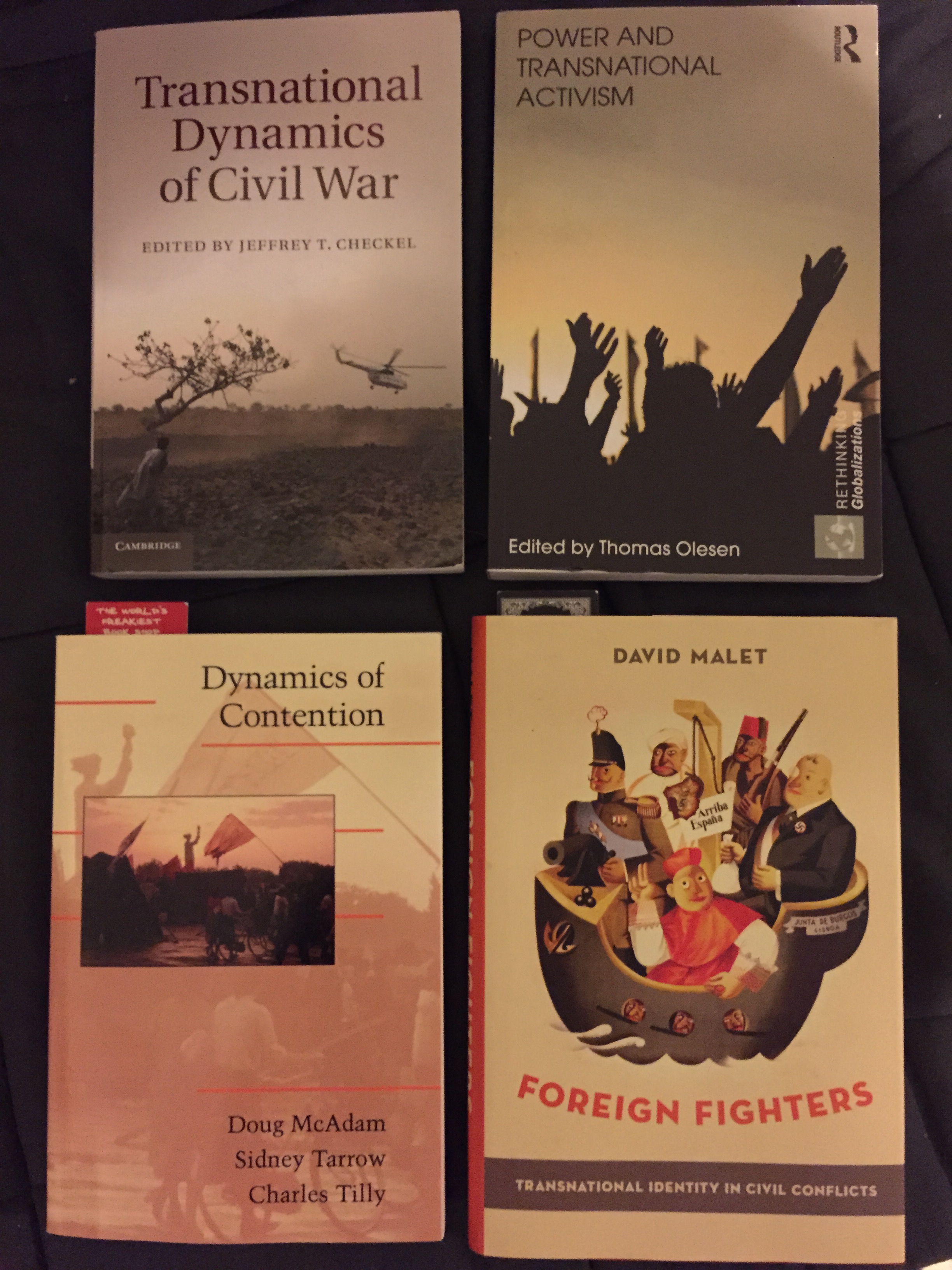
T books

M books

For a while now my research has mainly focused on Australian jihadism and I’ve been wanting to move beyond that. While I will still be doing research on that, it won’t be the focus of the PhD.

In other news, I had a paper published by the Lowy Institute recently: Australian Foreign Fighters: Risks and Responses.

Executive summary

Conflicts in Syria and Iraq have attracted aspiring jihadists from across the world. Australians have joined the flow of foreign fighters to the region, raising concerns that some will carry out terrorist attacks in Australia should they return home. The record of past jihadist foreign fighter mobilisations, including Australia’s own history in this regard, demonstrates that there is a potential threat to Australia’s security. However, a range of factors will shape that threat, including how Australia responds to returning foreign fighters.

The Government’s response has mainly focused on increased resources and powers for police and intelligence agencies, but also includes an important non-coercive element termed Countering Violent Extremism (CVE) that has received less attention. CVE has been a core element of the global response to foreign fighters, and has played a role in Australia’s counter-terrorism approach for several years. However, many past CVE measures are not directly suitable for the current situation. Australia can learn valuable lessons from European countries, which have more experience in CVE and are already using such measures to address the current foreign fighter threat.

I wrote this op-ed on some of the paper’s key points.

Also, there are some new journal articles out on foreign fighters (all paywalled though):

Daniel Byman, “The Homecomings: What Happens When Arab Foreign Fighters in Iraq and Syria Return?“, Studies in Conflict & Terrorism, published online 1 May 2015.

Cerwyn Moore, “Introductory Comments to Foreign Fighters Research: Special Mini-Series“, Terrorism and Political Violence, published online 5 May 2015.

Jasper L. de Bie, Christianne J. de Poot & Joanne P. van der Leun, “Shifting Modus Operandi of Jihadist Foreign Fighters From the Netherlands Between 2000 and 2013: A Crime Script Analysis“, Terrorism and Political Violence, published online 5 May 2015.

Richard Bach Jensen, “Anarchist Terrorism and Global Diasporas, 1878–1914“, Terrorism and Political Violence, published online 5 May 2015.

David Malet, “Foreign Fighter Mobilization and Persistence in a Global Context“, Terrorism and Political Violence, published online 5 May 2015.

Cerwyn Moore, “Foreign Bodies: Transnational Activism, the Insurgency in the North Caucasus and ‘Beyond’“, Terrorism and Political Violence, published online 6 May 2015.

Finally, my friend Matteo Vergani has started a new social science blog, called Why Don’t I Get Those Results? Take a look!


Two articles: militant use of YouTube, and Tony Abbott’s “death cult” rhetoric

Two new journal articles by my Monash colleagues. Enjoy!


Pete Lentini, “Demonizing ISIL and Defending Muslims: Australian Muslim Citizenship and Tony Abbott’s ‘Death Cult’ Rhetoric“, Islam and Christian–Muslim Relations, Volume 26, Issue 2, 2015

Abstract:

In the lead-up to Australia committing military resources and personnel to the coalition opposing the Islamic State in the Levant (ISIL), Prime Minister Tony Abbott consistently categorized the al-Qaeda splinter group as a “death cult.” Examining Abbott’s official rhetoric on ISIL and the threat it poses to Australia and the world, this article argues that his use of the term “death cult” reflects patterns in Western political demonology and demonizing enemies, namely, creating adversaries as monsters by highlighting the atrocities they commit in order to garner support for (often lethal) actions against them. In traditional political demonology, establishment representatives often target minority or marginal groups as these pariahs. However, in demonizing ISIL, Abbott deliberately made distinctions between it and its members and the majority of Muslims, including Australian Muslims, and utilized political demonology differently. In so doing, he affirmed this religious minority’s status within the parameters of Australian citizenship. This is indeed commendable. However, Abbott rarely mentioned Muslims outside of references to terrorism. Despite the fact that Abbott acknowledges that only a comparative handful of Muslims are indeed violent, he has not yet fully engaged with the broader notions of Australian Muslims’ contributions to Australian society and their citizenship.


Matteo Vergani and Dennis Zuevb, “Neojihadist Visual Politics: Comparing YouTube Videos of North Caucasus and Uyghur Militants“, Asian Studies Review, Volume 39, Issue 1, 2015

Abstract:

YouTube videos offer a rare opportunity to gain an insight into the sequestered world of neojihadism. This study examines and compares the lines of the visual narrative associated with two Asian insurgencies that help to form the global Islamic social movement: the insurgency in Chechnya (North Caucasus) and that in Xinjiang (China). The purpose of the article is to describe the narratives used by the Islamic militants addressing the conflict and to identify similarities and differences in the use of visual rhetorical techniques by neojihadist groups to propagate their worldview. The study of the visual narratives promoted in the videos will help to provide a better understanding of the impact of the neojihadist narratives on the creation of collective identities. Our findings suggest that these narratives have similar features, which can be identified in a set of sub-narratives. Within the common pattern, however, significant differences can be found, especially in the interpretation of the videos by the audiences.

Resources: Ukraine’s foreign fighters

Most discussions of foreign fighters (including on this blog) focus on Sunni Muslims joining ISIS, Jabhat al-Nusra and other jihadist groups to Syria and Iraq. But there are other interesting foreign fighter flows worthy of research attention. Phillip Smyth produced this excellent report on Shia Muslims joining Iranian-backed militias in Shia and Iraq. There are also people, often Westerners, travelling to join Kurdish groups in the region fighting against ISIS.

The Ukrainian conflict has also attracted foreign fighters. Since the war began in early-to-mid 2014, small numbers of foreigners have travelled to join extreme-right militias on both sides. This is not an issue I’ve been following much at all, so this post provides a brief collection of links for anyone else interested in it.

Media articles:

Ukraine: Far-Right Fighters from Europe Fight for Ukraine“, Eurasianet, 6 August 2014.

Ukraine War Pulls in Foreign Fighters“, BBC 1 September 2014.

Is Europe Overlooking the Far-Right ‘Foreign Fighter’ Issue in Ukraine?“, Huffington Post, 23 January 2015.

Reports:

Ukraine’s Far-Right Forces“, Hate Speech International, 3 February 2015.

Neither ‘NATO’s Foreign Legion’ Nor the ‘Donbass International Brigades:’ (Where Are All the) Foreign Fighters in Ukraine?“, PISM Policy Papers, 30 March 2015.