Australia’s counter-terrorism tranches

The new parliament will soon pass more national security (mainly counter-terrorism) legislation. This has happened every few months from late 2014, following the increased terrorist threat resulting from the Syrian civil war and the rise of the “Islamic State”.

Commonwealth Attorney-General George Brandis has popularised the term tranche for each of these new sets legislation. These tranches can be hard to keep track of, and generate a lot of controversy. So this post outlines the tranches so far, with a few thoughts on the debates about them.


Tranche 1: National Security Legislation Amendment Bill (No. 1) 2014

The first tranche was mainly about implementing the recommendations of the 2012 national security inquiry, and most of it was reasonable. Some of the critical commentary was way off the mark, with unfounded claims that the bill would legalise torture and allow ASIO to monitor “the entire internet” with one warrant.

I only had a few objections to this bill. For example, it made sense to allow ASIO officers to conduct “special intelligence operations” (that is, to infiltrate terrorist cells without the fear that they could face prosecution for breaking laws in the process), but I objected to the disclosure restrictions in Section 35P which went beyond the AFP’s disclosure restrictions for controlled operations, but with less oversight.

The disclosure restrictions have since been eased, to some degree, following the Independent National Security Legislation Monitor (INSLM)’s inquiry into Section 35P.


Tranche 2: Counter-Terrorism Legislation Amendment (Foreign Fighters) Bill 2014

The second tranche was much more worrying. It introduced the declared area (or “no go zone“) offence, where Australians returning from declared areas in Syria and Iraq would have to prove they weren’t terrorists. The tranche also merged foreign incursions offences and terrorism offences together in a very blunt manner, and introduced new restrictions on speech.

However, this tranche also had bits I strongly agreed with (particularly relating to passports and foreign evidence) and bits I was wary of but acceptted (such as lowering thresholds for several existing powers like control orders, though this was done without adding the control order safeguards recommended in the COAG CT review).


Tranche 2.5? Counter-Terrorism Legislation Amendment Bill (No.1) 2014

This was quickly followed some small changes that were not announced as a “tranche”, because they were mainly about tweaking some of the previous tranche. So they could be considered a sub-tranche, and they mainly involved more adjustments to control orders and intelligence-sharing.

One problem with this tranche, which was fortunately fixed by the Parliamentary Joint Committee on Intelligence and Security (PJCIS), was that its initial draft would have removed some of the judicial discretion on control orders. Traditionally, a judge who approved a control order could scrutinise each proposed restriction on the suspect’s liberty and reject any restrictions that the police couldn’t sufficiently justify. Read the Harun Causevic ruling to see this process playing out.

The original version of this bill would have taken that discretion away, meaning that a judge could either say yes to a control order, accepting every restriction the Federal Police called for, or say no altogether. Fortunately the PJCIS rejected this, and the government accepted that, so each restriction on liberty can still be argued over in court.


Tranche 3: Telecommunications (Interception and Access) Amendment (Data Retention) Bill 2014

Then there was the third tranche, data retention. I wasn’t instinctively opposed to data retention but was largely sceptical, given the risks it carries for personal liberties, doubts that the data would be kept securely, the risks posed to press freedom and the poor record of data retention in some other countries.

I’m also sceptical of several arguments from the anti-data retention side, such as that no counter-terrorism or public safety benefits will result at all from it. The UK’s Independent Reviewer of Terrorism Legislation’s latest report found benefits from bulk data collection(though that’s not quite the same thing).

But on the whole, I’m still unconvinced that the benefits will outweigh the risks.

Now that we have data retention, a big question is how to evaluate it. What sort of review could be done to examine the first year or more of data retention and test the arguments of each side? It would probably be too big for the INSLM, who’s job only goes for 60 days per year. We are due for another external review of Australia’s intelligence agencies (the Flood Review recommended one every five to seven years and the last one was in 2011), civil society groups could push for it to include an examination of what difference data retention has made so far.


Tranche 4: Australian Citizenship Amendment (Allegiance to Australia) Bill 2015

Next came the fourth tranche, the citizenship-stripping bill. For the first time ever, I was 100% opposed to a piece of national security legislation.

The PCJIS’s amendments have removed many of its worst aspects. The original draft could strip the citizenship of Australians within Australia who hadn’t been convicted of a crime, and listed “damage to Commonwealth property” as one of the offences that could result in this. It also may have had an evidence threshold lower than that of confiscating passports (it’s unclear, see pages 6-7 here).

Thanks to the PJCIS’s changes, the bill that ended up passing is not nearly as bad. However, it still allows for Australians suspected of terrorism (provided they are dual-nationals and overseas at the time) to lose their citizenship without being convicted, thanks to a “self-executing” clause. This obfuscating term caused a lot of debate in the PCJIS hearings and hid that a group public servants (which we know now will be in the form of the Citizenship Loss Board) will decide which dual-national Australians will lose their citizenship, without guilt being proved.

Within Australia, it can only be used against dual-nationals who have been convicted. However, even if the law is used only against undeniably genuine terrorists, I don’t see merit in it.


Tranche 5: Counter-Terrorism Legislation Amendment Bill (No.1) 2015

Then we had the fifth tranche, which we are still in the middle of. It mainly involves adjustments to control orders, such as lowering the age of who they can be used against (from 16 to 14) and allowing the use of secret evidence in control order proceedings.

When the PJCIS released its report on the bill, the government announced it would pass it. This then got put aside, presumably because the double dissolution election got in the way or because they were waiting for Part 2 of the INSLM’s report on control order safeguards.

On Thursday, Turnbull said that the bill’s new version would be presented soon. We haven’t seen it yet, but if the “special advocates” recommendations are implemented (so that the secret evidence can be challenged), I don’t find this tranche a huge worry in itself.


Tranche 6: indefinite detention?

There will soon be sixth tranche, which I’m deeply apprehensive about.

In August a COAG meeting of Attorneys-General agreed to introduce legislation to detain convicted terrorists who had served their sentences if they were deemed to pose an unacceptable risk. Their detention would be reviewed periodically, and could be indefinite. On Thursday Turnbull announced that these laws would be presented to Parliament soon, along with other changes.


So these are the tranches that we have had, or are about to have. Given the threat, several of the changes were justified. However, the overall trend is excessive and illiberal, and looks set to continue.
Videos: ANU Strategic and Defence Studies Centre’s 50th anniversary conference

I recently went to the 50th anniversary conference for the Australian National University’s Strategic and Defence Studies Centre, which was a lot of fun.

The videos are all up on the ANU’s YouTube channel, but for convenience I’ve embedded them here, with the lists of speakers.

There were five sessions, all included below. I particularly recommend the talk by Evelyn Goh. Her question, about whether grand bargains between great powers are actually possible, is hugely relevant for Australia given growing tensions between the US and China. I’m sceptical of her argument (I’m pessimistic about grand bargains and consider the idea to be a huge gamble), but it’s an important position to debate. I also really liked Amy King’s talk, as economic aspects of security are something I wish I knew better. The talks about strategic studies as a field (of study and practice) by Peter Ho, Eliot Cohen, Hew Strachan, Amitav Acharya and Robert O’Niell are also great.

Also, some people have recently asked me if my PhD is in strategic studies, because I’ve had so many blog posts on strategic and military issues this year. It’s not. I’ve just taken a lot of interest in strategic studies this year, in part because it’s not part of my PhD, but also because the history of its contentious relationship with both the state and the academy fascinates me (which has obvious parallels with terrorism studies).


Session 1: Strategy and Power
Chair: Professor Michael Wesley

21st Century Strategic Order – Dr C. Raja Mohan

Economics and Strategy – Dr Amy King

Elements of National Power and Strategic Policy – Major General John J. Frewen

Great Power Grand Bargains: Myth or Reality? – Professor Evelyn Goh


Session 2: Strategic Thinking: Concepts and Challenges
Chair: Emeritus Professor David Horner

Old Wine in New Bottles? The Continued Relevance of Cold War Strategic Concepts – Professor Robert Ayson

Alliances After the Cold War – Professor Thomas Christensen

Nuclear Strategy After the Cold War – Dr Nicola Leveringhaus


Session 3: Strategy and Domains
Chair: Professor Joan Beaumont

The Return of Geography – Professor Paul Dibb

Maritime Strategy in Asia – Dr Euan Graham

The Evolution of Military Capability in the Indo-Asia-Pacific Region – Dr Tim Huxley


Session 4: Strategic Studies in Practice
Chair: Admiral Chris Barrie

Strategic Studies in Practice: The Australian Perspective – Professor Hugh White

Strategic Studies in Practice: The Southeast Asian Perspective – Mr Peter Ho

Training the Next Generation of Strategic Thinkers – Professor Eliot Cohen


Session 5: New Directions in Strategic Studies
Chair: Professor Daniel Marston

US Grand Strategy in the Post-Cold War Era – Dr Hal Brands

The Future of Strategic Studies: Lessons from the Last Golden Age – Professor Sir Hew Strachan

An Asian School of Strategic Studies? – Professor Amitav Acharya

The Future of Strategic Studies: The Next Golden Age – Professor Robert O’Neill

Great expectations in the South China Sea

When Australia’s last Defence White Paper was released, Hugh White declared that “it’s time we talked about war with China”.

Hugh White has long been calling for discussion on this hopefully remote, but unfortunately real, possibility. And he’s absolutely right. I’m going to talk about it in this post, and highlight voices on this topic that I find valuable.

First, because I’ve enjoyed venturing outside my research area recently. Second, because the prospect of war in the Asia-Pacific poses a greater threat to Australia’s national security than terrorism. Third, because I recently listened to a Perth USAsia Centre podcast episode where Kim Beazley said something about this which really struck me.

In the episode, Beazley and others discussed the latest Shangri-La Dialogue. This is a summit in Singapore where representatives of Asia-Pacific governments, along with academics and other participants, discuss the region’s security and defence issues. Beazley said that Australia stood out by failing to attend the Dialogue. He speculated that this could have been because America has big expectations of Australia in the future, and that the government has hesitantly signed Australia up without bringing the public along:

We don’t understand how significant we are, and if we ever approach, mentally, a comprehension of that we run away from it. … So we weren’t there. We had officials there, but we did not have a minister there. That’s simply absurd………

The Americans arrived with messages for us. I have a fear that maybe that’s what we were trying to avoid. The American message for us was really quite strong. It’s the first time I’ve heard this expression, and that was ‘well now Australia is a global ally’ and we engage in a variety of activities around the globe. We have become, from the American point of view, the ally they want to deal with. Because we’ll commit. We’ll commit forces, we’ll commit diplomacy, and I think there’s a sort of, bit of a hesitancy now, in Australia, on that point.

Is that actually where we want to be? If you read the White Paper yes it is where we want to be. The White Paper mentions a priority of support for a global rules-based order, it mentions it as often as [US Secretary of Defense] Ash Carter did in his speech.  And that would seem to be logically the point of intersection, but there was no Australian there to give that definition. And we always get mentioned in American speeches, but not in a way that singles us out and actually puts us up, elevates us, in discussion, pretty much above most other American allies. [Emphasis added]

These increased expectations on Australia need to be understood in light of the possibility that war could break out with China. That dark prospect lurks in the background of all the discussions of a “global rules-based order”, that America, Australia and other countries are vowing to uphold.

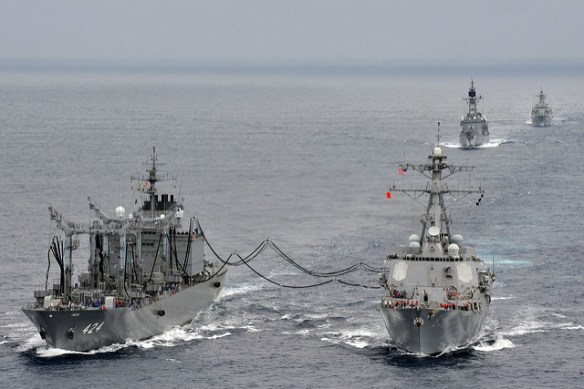
US Aus navies(Ships from the American, Japanese and Australian navies in a joint training exercise)

Before going into Beazley’s comment, I need to set the scene. The “global rules-based order” refers to the current system of international law for resolving territorial disputes, which has come under challenge in the Asia-Pacific. Global economic power is shifting to the region (hence the Asian Century) and it’s strategic importance is growing with it. Asia-Pacific countries have increased their military spending, nationalism and territorial competition are growing, the United States is perceived to be in decline, and military tensions are flaring up.

Many of these centre on territorial disputes in the South China Sea, which caused some tense moments in the Shangri-La Dialogue this year. China had been militarily asserting a claim to territory claimed by the Philippines. The International Tribunal for the Law of the Sea at The Hague was considering the dispute, and was anticipated to rule in the Philippines’ favour. China was expected to reject this, and made that clear at the summit when Admiral Sun Jianguo declared “China will not recognize nor honor any award”.

The Philippines is not the only country China is making territorial claims against, hence Hugh White’s argument that this “is a contest over the future of the Asian order, and we should not for a moment assume that China is any less committed to building a new order than we are to preserving the old one.” Tanner Greer similarly expresses pessimism about the likelihood of China being bound by the Western-led “global rules-based order”:

The Chinese believe that our international order is a rigged system set up by the imperial victors of the last round of bloodshed to perpetuate the power of its winners. They use the system, quite cynically, but at its base they find it and its symbols hypocritical, embarrassing, outrageous, and (according to the most strident among them), evil. In their minds it is a system of lies and half-truths. In some cases they have a point. Most of their actions in the East or South China Seas are designed to show just how large a gap exists between the grim realities of great power politics and soaring rhetoric Americans use to describe our role in the region. …..

Wedded to this cynical vision of the current arrangements is an equally cynical take on the history of America’s imposed order. Beijing is well aware that if it decided to do to Tonga now what the United States did to Hawaii more than a century ago it would mean war. At the time the United States suffered nothing of the sort. Not that American wars were without their own rewards—the Americans claim island bases like Guam and Saipan as prizes won through conquest. China is not allowed to conquer its own prizes. It cannot fight wars to give its forces a new ports and bases; it is not even allowed build little artificial islands for the purpose.

Never mind that all of that strikes the Chinese’s ire happened generations ago. Anything this side of the Taiping is modern history for the Chinese. American attempts to deny that, to claim that the world should work differently now than it did when the American star first began to rise, simply prove that morality and sweet sounding words like ‘international norms’ are for the winners. All of that talk about being a responsible stakeholder is just a nicer way to say we plan on kicking down the ladder now that we have finished climbing up it.

In simpler terms, the Chinese equate “rising within a rules based order” with “halting China’s rise to power.” To live by Washington’s rules is to live under its power, and the Chinese have been telling themselves for three decades now that—after two centuries of hardship—they will not live by the dictates of outsiders ever again.

Tanner Greer quotes Bilahari Kausikan’s account of how these ambitions are tied to the Chinese Communist Party (CCP)’s efforts to retain power:

China’s use of history to legitimise CCP rule and justify sovereignty claims gets us, I think, to the crux of the matter. For the past century, the legitimacy of any Chinese government has depended on its ability to defend China’s sovereignty and preserve its borders. But what are those borders? Can the CCP meekly accept the borders imposed on a weak China that has now, to use Mao Zedong’s phrase, “stood up” under communist leadership? China is not reckless but the CCP must at least give the appearance of recovering lost territory. Revanchism is an intrinsic part of the story of China’s “Great Rejuvenation”.

The lands lost to a weak China include what are now parts of Siberia and the Russian Far East, Mongolia, Hong Kong and Macau, and Taiwan, as well as the Paracels and Spratlys in the SCS. Siberia and the Russian Far East and Mongolia are now beyond recovery. Hong Kong and Macau reverted to Beijing’s rule almost 30 years ago. The US has made clear it will not support independence for Taiwan. Without US support, independence is impossible. With that core concern assuaged, Beijing can multiply the economic threads binding Taiwan to the mainland and bide its time, confident that irrespective of internal changes and how the people of Taiwan regard themselves, Taiwan’s long-term trajectory cannot run counter to China’s interest. Changing the status quo is not an immediate possibility but is no longer an urgent issue, although China still eyes Taiwan’s Democratic Progressive Party distrustfully and will never entirely forgo the option of forceful reunification.

That leaves the SCS territories to put some credible shreds of meat on the bare bones of the CCP’s version of history as it navigates a second and more difficult phase of reforms and tries to manage social and labour unrest at a time of moderating growth and a future when slower growth will be China’s “new normal”. The very insignificance of the territories in dispute in the SCS may well be part of their attraction to Beijing for this essentially domestic political purpose.

This is extremely plausible, and not unique to this part of the world (Curtis Ryan and others have described how regime insecurity drives foreign policies and conflict in the Middle East). Barry Buzan similarly links the Chinese government’s commitment to retaining power at home to its military assertiveness abroad:

As Jonathan Fenby has argued, the CCP remains unbendingly committed to remaining in power in perpetuity. Yet as knowledge, wealth, organization, information and connectivity spread through Chinese society, that society becomes increasingly diverse, opinionated, and able and willing to mobilise in its own interests.

The CCP increasingly, and correctly, feels threatened by this society, which it does not understand, and does not like. As a consequence, China’s domestic and foreign policies are extremely closely linked, with the insecurity of the CCP as the central concern (see work by Susan Shirk and David Shambaugh). ….

The CCP has successfully cultivated nationalism for several decades, and while it has drawn legitimacy from that, it has also become trapped it into a ratchet effect of strong foreign policy responses. Because of its domestic insecurity, the CCP cannot afford to look weak abroad lest it invite comparison with the decaying Qing dynasty during the nineteenth century and lose the mandate of heaven.

On that basis, we can predict, and indeed we can already see happening, that in the coming years China will become more nationalist, more xenophobic, and probably more assertive in foreign policy terms (on a more assertive Chinese foreign policy, see Yan Xuetong and Zhang).

The Chinese government rejects the accusations against it, and they could certainly point to many hypocrisies. They could argue that as the largest contributor to United Nations peacekeeping missions, and as a country that that didn’t invade Iraq without UN approval in 2003 or carry out regime change in Libya in 2011, it’s hypocritical for Western countries to call China a threat to global order. They could argue that as a country that provides aid to others with few strings attached, and whose imports have driven economic growth for many countries (such as Australia’s mining boom), it’s ungrateful of others to rebuke China for seeking increased military strength in proportion with its growing economy. They could also argue that Australia itself spurned international arbitration during its oil and gas disputes with Timor-Leste, and that China is not the only country that could be accused of making problematic claims in the South China Sea.

But there’s little doubt that China’s maritime claims have been more ambitious, and its actions more aggressive, than the other countries involved.

South_China_Sea_claims_map

To assert its claims, China has been constructing artificial islands in disputed territory and building military bases on them. The Asia Maritime Transparency Initiative provides plenty of satellite photos of this. China has also been intruding into waters that unambiguously belong within other country’s Exclusive Economic Zones (EEZs), and provoking confrontations:

China has carefully—but aggressively—pursued its goals in Asia. It has seized territory (the Scarborough Shoal) from the Philippines and refused to withdraw  despite promising to do so.3 It stationed an oil rig in Vietnamese waters, and established an East China Sea air-defence identification zone without first consulting its neighbours. It has intercepted US aircraft and naval vessels in reckless  ways, thus risking a repeat of the April 2001 EP-3 crisis. The Chinese Coast Guard continues to  aggressively defend Chinese fishing vessels operating in the waters of Southeast Asian countries, like Indonesia.4

This  approach has spurred countries such as Singapore and the Philippines to seek closer military ties with the United States, when they had grown wary of such military ties not long ago (the Philippines closed US military bases in the 1990s). Even the Cold War enemy Vietnam is seeking military support from America. This does not mean that conflict is inevitable (the new Philippines government may well accommodate China), and it is not necessarily even likely. But the pieces are in place for a potential confrontation, and there’s a real possibility that things could get out of control.

China does appear to sternly reject the current international order, viewing it as a Western trap, while the US and others appear determined to maintain this order. Unless one or both sides change their approach, the region’s future could be bleak.

This is the context to understand Beazley’s comment in. He paints a picture of Australia becoming further embedded in the US alliance system, in which the US would have high expectations of Australia in any conflict with China. But he suggests that governments have done this without having brought the public on board.

Several other foreign policy observers have also pointed this out. The Lowy Institute’s Aaron Connelly wrote this valuable post arguing that US government officials, who deal mostly with their counterparts in Canberra, don’t realise that the Australian public (and businesses) largely don’t share the US government view of a threatening China. Indeed a recent survey showed that Australians are calm about China’s rise and see the prospect of war as unlikely. The United States Studies Centre’s Simon Jackman viewed this as “Australians taking the US relationship for granted”.

If America indeed has great expectations of us, to help enforce a global order that the Chinese government appears to have emphatically rejected, then the alliance certainly can’t be taken for granted. Either the government will need to temper America’s expectations in line with the Australian public’s, or the government will have to persuade the public that committing more to the alliance is necessary.

In the latest Quarterly Essay, Firing Line: Australia’s Path to War, James Brown similarly warns about the risk of war with China and highlights the gap between successive Australian governments’  integration into the US alliance system and public hesitancy. He argues that the government needs to more open than it has so far, so that an informed choice can be made:

Australia’s politicians, seldom comfortable discussing military strategic issues, did little to address the growing chorus of alarm. In fact, they did little to explain the measures agreed to with the United States at all. When Prime Minister Tony Abbott signed the Force Posture Agreement formalising the Darwin presence [of US Marines] in 2014, there was no accompanying attempt to explain to the public what it meant.

Brown ties this into a broader theme, arguing that Australia has limited public engagement with, and scrutiny of, military issues. He states that our defence community is more closed than that of America and some other democracies, and that it’s rare for politicians, journalists and academics to have deep military knowledge.

That said, there are signs of this changing: the increased public consultation behind the latest Defence White Paper, the Army’s “intellectual pivot” (a factor behind the rise of Australia’s online strategy-sphere), and the chorus of voices calling for more discussion of defence issues in this election.

But this could go much further. If, as Beazley worries, America does indeed have great expectations for Australia in the event of war with China, it certainly doesn’t appear to be in the public consciousness. It’s indeed time we talked about it more.

Launch date for secret side project

Kate Grealy and I will soon launch our side project.

I won’t tell you everything about it yet, but it will cover some similar themes to this blog (security issues and human rights), though with a wider range of topics and a greater focus on Southeast Asia. It will feature many interesting and well-informed people.

It’s been a lot of fun for us over the past few months, and we are pleased that we are just about ready to launch, which we will do on Thursday 9 June.

Security studies versus strategic studies: a history – part 2

This is the second part of this post on security studies and strategic studies. Be sure to read that post first.


Rise of strategic studies

As discussed in the last post, security studies began in the 1930s with a group of Ivy League scholars in the United States. These scholars were concerned about the threat to liberal political order posed by totalitarian states like Nazi Germany and the Soviet Union. This emerging field came to overlap with the discipline of international relations (IR), which had developed in the UK, US, Europe and elsewhere after World War One.

By the end of World War Two, the relatively new concept of national security became a driving concern for the US government, which passed the National Security Act in 1947 as it prepared to confront the Soviet Union in what became the Cold War. The government, particularly the military, invested heavily in the social sciences as the country mobilised to face a new and powerful enemy. This investment helped the field of security studies to rapidly expand.

Within security studies, a stream developed that focused on military strategy, particularly on nuclear weapons. They were led by scholars concerned about how America could face a world where the next global conflict could be apocalyptic. Over time this would became a distinct field known as strategic studies.

Strategic studies never fitted neatly into any one discipline, as it included political scientists and international relations specialists, but also mathematicians, physicists, economists, and many historians. Nor was it a purely academic field. Some of its key figures were based in universities, but others were based in institutions such as the Rand Corporation (a think-tank created to conduct research for the military) and there was considerable crossover with government. The career of Thomas Schelling, an economist who worked for the US government from 1948 to 1953 on initiatives such as the Marshall Plan and went on to write influential books on arms control and game theory, exemplifies the eclectic nature of the field. More infamous, but less representative, strategic studies scholars included Herman Khan, a theorist of nuclear warfare who inspired the eponymous character in Stanley Kubrick’s Dr. Strangelove.

The field  focused on nuclear deterrence, making use of game theory and formal modelling. Their major concern was how to reduce the risk of nuclear war and control the arms race. At the same time, they were concerned with maintaining America’s military dominance. Whether there were tensions between these positions depends on one’s political stance. To these scholars, America’s military superiority and dominant global position reduced the prospect of global war, by discouraging Soviet and Chinese adventurism and reassuring allies, and therefore helped maintain international security. To their critics, America’s military dominance led to reckless actions and encouraged the global arms race, thereby undermining international security.

While nuclear deterrence was the field’s main focus, it was not the only one. When nuclear tensions began to ease after the 1962 Cuban missile crisis, a few strategists turned to another dimension of Cold War confrontation: insurgency and counter-insurgency. Thriving insurgencies in Algeria and Vietnam, or failed insurgencies in Greece, the Philippines and Malaya, became the focus of study for this segment (a focus that would be temporarily revived in the mid-2000s). However, the failing counter-insurgency in Vietnam prompted a crisis in academic-military relations that would make strategic studies fall out of favour.


Turmoil in academia

Social change in the 1960s and 1970s ruptured the relationship between academia and state agencies such as the military.

The global context had changed since the 1930s and 1940s. The United States had become the most powerful country in the world. It had military bases across the globe. It provided military support to Western-aligned governments in most continents. It overthrew several governments (including democratically elected ones) that tried to move outside the Western orbit. By the late 1960s, it was deploying extraordinary levels of military force in Vietnam, Cambodia and Laos. The idea of America as an embattled defender of freedom had a weaker hold on public, and particularly scholarly, opinion.
Vietnamprotestors

(students protesting outside the Pentagon in 1967)

As opposition to the war (and broader disquiet about America’s role in the world) grew, military involvement with higher education became controversial. Many academics felt that cooperation with the military and foreign policy arms of the state had corrupted the role of universities. One of the most prominent critics was MIT linguistics professor Noam Chomsky. His first book, American Power and the New Mandarins, focused heavily on academia. Social scientists were foremost among the “mandarins” referred to in the title. Those whose research was intended to assist the war effort in Vietnam were accused of having “the mentality of the colonial civil servant, persuaded of the benevolence of the mother country and the correctness of its vision of world order, and convinced that he understands the true interests of the backward peoples whose welfare he is to administer”.

Chomsky, as an anarchist, was among the most radical of the critics. But as Adam Elkus points out, you don’t need to share Chomsky’s politics to have had ethical problems with some of the academic-state collaboration that was happening. One social scientist, Samuel Huntingdon, was apparently involved in the Strategic Hamlets program which drove hundreds of thousands of South Vietnamese peasants out of their homes. Another example is Henry Kissinger, who used his academic position to promote false claims of Soviet nuclear advantage (and that’s without getting into his future government career).

So it’s not surprising that opposition to research intended to assist military policy became widespread. Senator J. William Fulbright, an anti-war figure who came from a conservative tradition, similarly denounced the “military-industrial-academic complex”. Opposition grew, and had lasting effects:

The American university today would not accept what Chomsky took for granted in the 1960s. Anthropologists tend to be wary of working with the U.S. military in Iraq or Afghanistan. Sociologists are more inclined to identify with critics of American foreign policy than with its architects. MIT is more likely to teach courses in sustainable development than political development. There are precious few old mandarins left in the discipline of political science, let alone emerging new ones. One half of the evil axis identified by Chomsky is gone: work for any government agency, particularly the Central Intelligence Agency, and your chances of getting tenure will diminish with more than deliberate speed.


Fall of strategic studies

Strategic studies was one casualty of this rupture, and it gradually became a marginal field.

However, the political backlash was only one reason for its decline, and potentially an overstated one. The social sciences did not become dominated by “tenured radicals”, but they did experience a broadly leftward shift, resulting in discomfort with a field so closely identified with US military policy.

Another reason was that the easing of Cold War tensions with détente in the 1970s reduced the perceived need for the field, and there was also much disillusionment from the government end. Many government and military officials felt academia had provided useless input, if not interference, in matters that should be left to military professionals.

A further reason was strategic studies’ lack of a clear disciplinary home:

The main problem is not the pacifist or radical fringes of the academic world, despite the distaste they evince for a field they associate with support for U.S. policy. Neither groups has as much clout in political science as elsewhere in academia. The problem is that many in the liberal mainstream concede that strategic studies is legitimate, but when major war appears to recede as a prospect in the real world – as it did in the 1970s and again after the Cold War – they resist ranking the subject highly when their own fields’ priorities are at stake. Seen as legitimate in principle, strategic studies faces marginalization in practice when departments see it as a second-rate claim on their discipline.

That paragraph was written in the 1990s, but the field of strategic studies has not recovered since. Meanwhile, security studies went in a different direction.


Transformation of security studies

While strategic studies went through this drama, the broader field of security studies persisted and became even more closely integrated into the discipline of international relations. This was at first possible because the dominant IR paradigm (in the 1950s) of realism meshed closely with concerns of both security studies and strategic studies (which were not two clearly separate fields at the time).

That said, it was not always an easy fit. Edward Mead Earle had a strong distaste for the realism of E. H. Carr (mentioned in the first post), which contrasted with Earle’s idealised view of America. In addition, several realists opposed America’s Cold War posture and the Vietnam War. The most prominant was Hans Morgenthau, who drew parallels between the Vietnam War and Thucydides’s critique of the “Sicilian expedition” in 400s BC, an act of overreach that weakened the Athenian empire. This was consistent with his earlier realist critique of the Truman Doctrine. His objection was based on its universalistic nature; it committed the United States to fight any perceived communist threat, to anybody, in any part of the world, at any cost. Several other realists also critiqued America’s expansive ambitions and the Vietnam War, leading some of their hawkish critics to dismiss realism as a European import unsuited to an idealistic America. Nonetheless, both strategic studies and security studies were broadly compatible with realism.

Because security studies had a lot of crossover with international relations, the former gradually became closely integrated into the latter. Bazzy Buzan and Lene Hanson have shown, in great detail, how security studies went through a process of institutionalisation so that by the 1970s it had become a major sub-field within IR. As this occurred, security studies increasingly focused on international security (long an IR concern) and less on national security (which tended to be left to strategic studies, as the divide between the two fields gradually grew).

Then, the discipline of international relations changed substantially from the 1970s onwards. The realist paradigm came under challenge, not only from its historical competitor, liberalism, but also constructivism and other schools of thought such as Marxism, feminism and critical theory. The 2014 version of the Teaching, Research and International Policy (TRIP) Faculty Survey Report, which received responses from 4,903 IR scholars in 32 countries, confirms this. Asked to describe the “paradigms or schools of thought” their work fell under, less than a fifth (18.7%) of respondents chose realism. Instead 23.13% chose constructivism and 26.73% selected “I do not use paradigmatic analysis”. Realist dominance died long ago.

As a result, the field of security studies transformed too, and adopted a greater focus on non-military aspects of security. This included issues such as economic interdependence, poverty, environmental degradation and oil dependence (particularly after the 1973 OPEC embargo), along with enduring debates on what issues did and did not belong within security studies. The field now covers issues such as human security, environmental security, and securitisation.


The remaining divide

So security studies has now become an integral part of international relations (and by extension political science), with a relatively secure position within academia. Unlike its first decades, the field now rarely focuses on national security or military strategy, to the point that the field is often just called “international security studies”.

In contrast, strategic studies focuses heavily on national security and the conduct of war, rather than the issues currently favoured by security studies. Compared to the “golden age” of strategic studies in the 1950s and 1960s, it is a marginal field today. This is partly because of its interdisciplinary nature and partly because the academy is less hospitable to military interests than it once was (traditional military history has been another casualty of this). The field experienced a temporary and mild resurgence during the 1980s, but has been on the back-foot since.

The clearest way to see the differences between the two fields is to look at the contents pages of two key textbooks.

The online table of contents for Oxford University Press’s major textbook on security studies looks similar to an international relations textbook, with chapters devoted to schools of thought such as realism, liberalism, constructivism and critical theory. It also has chapters focused on many types of security other than military security.

The online table of contents for Oxford University Press’s major textbook on strategic studies focuses instead on military strategy and national security. Some of its chapter titles, “Strategic Studies and its Critics” and “The Future of Strategic Studies”, allude to the field’s precarious position.

Hence the divide discussed by Rovner and Elkus. In the early Cold War years, security studies and strategic studies were not two clearly distinct fields, and were not spoken of that way. But a divide developed, and grew, particularly from the 1960s onwards. They are now two separate fields, with different focuses, approaches, and worldviews. They have also had very different fortunes.

Security studies versus strategic studies: a history – part 1

War on the Rocks recently published an article by Joshua Rovner on the academic divide between security studies and strategic studies. Adam Elkus wrote a follow-up article elaborating on the differences and identifying ways that the fields could find common ground.

Several people on Twitter and Facebook remarked that they were unaware that security studies and strategic studies were actually two different fields, which made me realise that this is more of a niche distinction than I had thought.

So this two-post series will provide a history of how security studies and strategic studies formed and became separate (and sometimes warring) fields.

This first post covers the period up to the 1950s, before the stark divide had developed.

A few caveats:

  • I do not primarily identify with either field (except to the extent that terrorism studies might be considered part of security studies, broadly defined), so these two posts will have over-simplifications and possibly errors. Hopefully people in these fields will challenge or add to this short history.
  • This history won’t cover the methodological issues raised in the War on the Rocks articles.
  • This history will focus mainly on the United States.

International relations

To begin, we need to go back to before either security studies or strategic studies existed, and start with the discipline of international relations [IR]. Academic disciplines rarely arise from purely intellectual interest; instead they are influenced by wider political contexts and problems. The discipline of IR was established after the First World War, by scholars who sought to contribute intellectually to preventing global conflict, signified by the creation of Chatham House in the UK in 1920 and the Council on Foreign Relations in the US in 1921. As Fred Halliday notes:

Economics began as a reflection on problems of trade and the industrial revolution; sociology as a response to urbanization; political science in reaction to democratization and problems of governance; geography as a reflection on the rise of a world market and empire; psychology in response to a new awareness of mental illness. In the case of IR its academic origins lie in the response to World War One, as a reflection, mediate but engaged, on why the efforts of diplomats, lawyers, peace campaigners, industrialists, feminists, working-class leaders and the rest, were unable to stop the slaughter of 1914-18.

A particular intellectual approach, termed realism, gradually came to dominate the field. Initially the dominant theoretical approach was liberalism, strongly influenced by German philosopher Immanuel Kant’s ideals of international cooperation. However scholars who described themselves as realists challenged this approach, and emphasised international anarchy, the pursuit of power and the inevitability of conflict. A key realist text was E. H. Carr’s The Twenty Year Crisis, 1919-1939: An Introduction to the Study of International Relations, which was published on the outbreak of World War Two and seemingly validated by it. His 1946 preface to a republished version of the book accused the other theoretical approaches within IR of having “a glaring and dangerous defect… the almost total neglect of the factor of power”.

These aspects of the study of international relations – the desire to prevent global conflict, understand peace and war, and make sense of states’ competing pursuits of power – show that international security was a major focus of the discipline. But security was not initially considered a distinct field of study within the discipline, and there was no field of “security studies”. This only came about later, prompted by a largely separate academic development that occurred in the United States during this inter-war period.

(National) security studies

In the United States in the 1930s, an informal network of Ivy League scholars (such as Princeton’s Edward Mead Earle) began to create a distinct field of security studies. However, their focus was less on long-term notions of international security and more on national security. This was partly because their backgrounds were mostly not in international relations but in other disciplines (often they were historians). However, it was also because the 1930s were a less optimistic time for the democracies than the 1920s, given the Great Depression and the growing strength of totalitarian powers like Nazi Germany and the Soviet Union.

This distinction between national security and international security implied different focuses of study. While international security implied efforts to prevent or manage global conflict between states, national security implied efforts to assist their own states to face the dangers posed by conflict, and to prevail.

However, it’s important to not treat national security and international security as entirely different focuses; for this network of US-based scholars in the 1930s they went hand-in-hand. These scholars feared that the totalitarian powers were undermining the “relatively stable international order” that previously existed, placing the United States at grave risk. In particular, Nazi Germany’s challenge to international security undermined America’s national security.

The notion of national security, being a broader concept than military defence, provided a way to understand the danger posed by Hitler, whose military forces did not pose an immediate physical threat to America. The Roosevelt Administration and the foreign policy establishment, including these scholars, saw the need to go to war with Germany in the late 1930s but much of the public was reluctant. Edward Mead Earle believed that “the isolationist tendencies of the public would melt away when it was presented with a well-articulated national security policy.” As it happened, Germany’s ally Japan made the job much easier by bombing Pearl Harbour. This brought America directly into the war, and set the stage for a new international order.

United Nations Fight for Freedom Wikimedia Commons

From this point on, the concept of national security became central to US policy:

World War II gave rise to the era of national security. This was an idea that would be institutionalized within American government and popularized in wider society. National security supplanted the more limited concept of “defense”. The disorder of the 1930s planted the seeds of an intellectual rediscovery of strategy as an intellectual discipline, and new weapons of greater range and lethality stoked fears in defense debate. Edward Mead Earle at the Institute for Advanced Study at Princeton, along with Arnold Wolfers and Nicholas Spykman at Yale, led the academic embrace of the concept. But only after the United States formally entered the war did national security become an organizing principle for a new, complex bureaucracy. This would culminate in the creation of the Unified Command Plan of 1946 that placed large parts of the globe under geographically based military commands, and the National Security Act of 1947, establishing the National Security Council and the Central Intelligence Agency.

This increasing government focus on national security helped security studies to grow. It’s worth noting that there was initially only limited interaction between the discipline of international relations and the emerging field of security studies, given the national focus and disciplinary diversity of the latter. Earle in particular felt that much of the more optimistic IR scholarship had become redundant after the League of Nations had failed to uphold its mandate. However, there was certainly some overlap, particularly after the Second World War. The newly dominant IR paradigm of realism sat well with security studies, and many security scholars did focus on “the study of the nature, causes, effects, and prevention of war”, which was a key component of the IR agenda.

It would take time for security studies and IR to become closer. What happened first was the Cold War mobilisation, combined with the US government’s desire for increased academic expertise on national security. This was a boon for security studies and resulted in a distinctive research focus within it which would grow to become the field of strategic studies.

Rise of strategic studies

The imperative for scholarly focus on strategy (specifically on military strategy) was outlined in 1949 by Yale scholar Bernard Brodie. He believed that strategy was “not receiving the scientific treatment it deserve[d] either in the armed services or, certainly, outside of them.” With two nuclear-armed superpowers facing off, security scholars feared the next global conflict would be apocalyptic, so a greater government and scholarly understanding of strategy was considered necessary to avoid catastrophe.

These scholars were also concerned that a long struggle against a fearsome enemy could lead to the militarisation of society, at odds with the United States’ domestic traditions. They believed that a strong core of civilian expertise in military affairs was needed to avoid civilian deference to the military (other than in the more operational and tactical questions that were more likely to be considered a purely military domain). Later civilian officials came to appreciate alternative sources of strategic advice, because of frustrations with some generals like Curtis “Bombs Away” LeMay.

The field expanded rapidly in the 1950s and 1960s, in the context of the American boom in higher education, as the government and private institutes like the Ford, Carnegie and Rockefeller foundations invested heavily in the social sciences. Like area studies, strategic studies benefited from the expectation that it would give the United States the edge in its competition for global influence with the Soviet Union.

Strategic studies at this time was effectively a component of security studies. Government support helped turn strategic studies into a field in its own right, and it’s future looked bright.

But this would change. After the Vietnam War, the close relationship with government would hinder the field’s acceptance within academia. Meanwhile the broader field of security studies would become much closer to the discipline of international relations and establish a secure position within academia.

These changes will be covered in the next post.

Update 1: The second post can be found here.

Australia’s continuously expanding counter-terrorism powers

On the Friday before last, the Prime Minister and State and Territory leaders unanimously agreed on another expansion of Australia’s counter-terrorism powers. The proposed law would keep convicted terrorists, if they were deemed to be un-rehabilitated, detained after their sentences have been served.

The following Friday saw another news report on counter-terrorism legislation. The Australian reported on how decisions to revoke the citizenship of dual-national suspected terrorists (based on legislation passed in December) would be made.

The government has created a Citizenship Loss Board, which includes members of “ASIO, ASIS, the Australian Federal Police and a raft of bureaucracies, including the ­Attorney-General’s Department, the Immigration Department and the Department of Foreign Affairs and Trade”. According the report, the government is prioritising Islamic State (IS) members believed to be intending to return to Australia, but has still “cast the net as wide as possible”. It is currently unclear what role the judiciary will have.

These two reports, within the last fortnight, caused little controversy. But they demonstrate the illiberal trend that marked Australia’s counter-terrorism approach under the Abbott government, and which has become normalised under the Turnbull government.

Under Abbott, jihadist terrorism was portrayed as an unprecedented danger that required a constant rush of new laws. From September 2014 onwards, the government declared every few months that many of Australia’s counter-terrorism laws were inadequate and soft, and that new laws to increase the power of security agencies were needed.

To be clear, there are exceptional aspects to terrorism when compared to most other types of crime. These include:

  • the harm that one single major attack can do, in the form of mass deaths and injuries, enormous economic damage and dramatic political consequences;
  • the expectations on security agencies to intercept plotters and prevent attacks rather than just investigate attacks after they occur;
  • the transnational conflict aspect, whereby the terrorists are often inspired, assisted or directed by sub-state military entities at war with our society.

These aspects make some departures from traditional crime-fighting approaches justified, provided they are effective, proportionate, and consistent with human rights.

But most of these adjustments were already made a decade ago, with the legislative framework put in place by the Howard government after 9/11.

This older legislation did have problems, in that some parts went too far and others were unnecessarily complex. That was an unsurprising outcome of so much legislation being pushed through Parliament in such a short time (one international observer described Australia’s approach as “hyper-legislation”). But several of its core components were necessary and justified.

Measures such as passport confiscation, ASIO’s compulsory questioning powers, proscription of organisations and the criminalisation of preparatory activity for terror attacks, proved useful for Australia’s counter-terrorism efforts. Reviews by Independent National Security Legislation Monitor, and an independent review established by the Council of Australian Governments, judged these particular measures to be effective and appropriate. The jury is still out on some of the other measures introduced in that period, such as control orders.

So Australia already had a robust counter-terrorism regime. There was scope for changing some of the laws, given the evolving threat, changes in technology, and some of the shortcomings identified in the independent reviews. As the potential threat resulting from the Syrian conflict was apparent from at least 2012, there was an ideal moment for careful deliberation on how Australia could best adjust its laws.

Instead, there was little action at all until June 2014 (when IS seized Mosul and declared a “Caliphate”) and then we got another round of “hyper-legislation” in the form of constant tranches of new legislation.

With at least five tranches passed so far, Australia has a greatly expanded body of national security laws. Some of these measures were sensible and justified (fast-tracked passport confiscations, increasing ASIS’s ability to spy on Australian terror suspects overseas, allowing “special intelligence operations”), some were unjust (citizenship-stripping, no-go zones, the excessive media restrictions in the “special intelligence operations” legislation), and some were ambiguous (lowered thresholds on a range of existing powers like control orders). But regardless of where one stands on each specific law, it is clear that all the changes went in one direction.

They all involved increases in government power, explicitly at the expense of liberty.

This approach, of treating the terror threat as so exceptional that more and more departures from traditional rules of evidence and rights protections were constantly needed, was accompanied by apocalyptic rhetoric. While such rhetoric has been a feature of Australian security politics for over a century, it reached a remarkable level under the Abbott Government. Attorney-General George-Brandis described the threat as existential, while Foreign Minister Julie Bishop likened it to the Soviet Union.

The whole approach contributes to a wider polarisation. For some small parts of the community, this approach risks feeding fears that the current threat of al-Qaeda and IS-inspired terrorism is a catastrophic and unmanageable problem, contributing to the backlash against multiculturalism. For other small sections of the community, it risks feeding fears that terrorism is a phoney threat manufactured to increase state power and smear Muslims. Rather than facing the threat with calmness and unity, it encourages fear and unnecessary division.

When Malcolm Turnbull came to power, his rhetoric signalled a different approach. He did not portray the threat as catastrophic or frame it in a way that risked implicating Muslims collectively. His rhetoric acknowledged the seriousness of the threat but projected optimism about overcoming it.

However, even the inclusive language is under challenge, and the “hyper-legislation” approach has barely slowed down.

The news reports over the last fortnight, of potential indefinite detention post-sentence and the creation of the Citizenship Loss Board, show how normalised this type of law-making has become. Other ideas suggested by Federal and State politicians have included secret trials and 28-day detention without charge. With Federal MP Andrew Nikolic (who is now Chair of the Parliamentary Joint Committee on Intelligence and Security) having declared after the Paris attacks that civil liberties debates were now “redundant”, it looks like Australia will keep steadily heading down this path.


Critiques of terrorism studies: a brief introduction

Following on from my post on internal assessments of terrorism studies, this is a short post to introduce readers to critiques of the field, and some thoughts on where I stand myself.

There are four common types of critique, which are:

  • Left-wing critiques: These portray terrorism studies as uncritically accepting Western state priorities and assumptions, and consequently producing flawed analysis. See this example from Richard Jackson (or this shorter one).
  • Right-wing critiques: These portray terrorism research as forms of terrorist apologia or as attempts to push a ‘politically correct’ agenda. See this example from David Martin Jones and Carl Ungerer.
  • Policy-utility critiques: These contend that terrorism research rarely provides workable ideas for counter-terrorism policymakers and practitioners, and that academics just prefer to criticise rather than offer helpful suggestions. See this example from Mils Hills.
  • Methodological critiques: These contend that terrorism research usually lacks empirical rigour, and that it is theoretically under-developed and full of conceptual confusion. See many examples in this article by Lisa Stampnitzky.

The political critiques (‘political’ not in the pejorative sense but in the sense of being concerned with politics of such research and its potential impact on people’s lives) are widespread, and anyone researching in the area will regularly encounter them. In their worst variants, the political critiques mean that terrorism studies gets slammed as either a haven for right-wing academic frauds who have sold their souls to state power to demonise official enemies, or as a haven for left-leaning namby-pamby academics who would rather hug terrorists than have them be defeated. This is best seen in the rage that the Brookings Institution’s Will McCants generates from such opposing types such as Glenn Greenwald and Robert Spencer.

In their stronger variants, these political critiques need to be reflected on and engaged with.

My own position is not neutral; I don’t find both sides to be equivalent. Instead, I find some variants of the leftist critiques compelling. It’s certainly true that the field mainly focuses on groups that threaten Western countries. I disagree quite a lot with the work of Arun Kundnani, particularly Chapter 4 of his latest book (the field focuses far less on religious ideology as a causal factor for terrorism than you would expect from his writings), but everyone in the field should read it. These types of critique are particularly important because they often come from members of communities subjected to stigmatisation and harmful policies in the name of countering terrorism.

I find the right-wing critiques weaker, which is likely a result of my own politics tending to be centre-left liberal. But there’s been some times when I’ve found the right-wing critiques to hit the mark. For example, some scholarship on Hezbollah has indeed indulgently accepted their denials of involvement in terrorism.

I’m sympathetic to the policy-utility critiques, but am also wary of the risks of imposing narrow conceptions of policy-relevance on academia.

And last, I agree a lot with the methodological critiques, as would much of the field. As noted in my post on internal assessments, the emerging dominant view is that the field has dramatically improved in the past five to ten years, but that we definitely have a long way to go.


Update 1: Changed the Mervyn Bendle example to one by David Martin Jones and Carl Ungerer, on 5 April 2016.

Terrorism and the new Defence White Paper

The new Defence White Paper describes Australia as entering a more unpredictable and potentially more dangerous world. It frequently mentions terrorism, almost twice as much as earlier White Papers do, as a worrying element in Australia’s strategic outlook:

Events during the three years since the release of the last Defence White Paper in 2013 demonstrate how rapidly Australia’s security environment can change. The relationship between the United States and China continues to evolve and will be fundamental to our future strategic circumstances. Territorial disputes between claimants in the East China and South China Seas have created uncertainty and tension in our region. The Democratic People’s Republic of Korea continues to be a source of instability. State fragility has helped enable the rise of Daesh (also known as Islamic State of Iraq and the Levant) terrorists in the Middle East, incidents across the world have demonstrated the pervasive nature of the threat of terrorism, and a violation of international law led to the deaths of Australians in the skies over Ukraine.

Yet Defence often isn’t perceived as having much of counter-terrorism role. For example, Allan Behm’s Strategist post on the White Paper said that:

Similarly, terrorism isn’t ultimately a defence matter. It’s evidently a law enforcement and intelligence issue, and some elements of the ADF capability (particularly the precision assault skills of the SAS) are applicable in certain situations.

This is true domestically, but internationally it underplays Defence’s role, which has gone beyond “certain situations” to become almost routine. The Australian Defence Force has directly fought groups like al-Qaeda and IS. The ADF engaged in combat against al-Qaeda during the initial invasion of Afghanistan, and al-Qaeda elements were among the insurgent groups Australia fought in Afghanistan in subsequent years. Recently, the RAAF has carried out air strikes against IS in both Iraq and Syria. While IS should not be seen as purely a terrorist problem, and nor should the insurgency in Afghanistan, this does demonstrate the ADF’s extensive use in operations against proscribed terrorist organisations.

It’s not just direct operations, as the ADF has more commonly played a counter-terrorism role through what’s called ‘building partner capacity’. Much of their role in Afghanistan involved training local forces. Australia has also helped train units of regional militaries, such as in Indonesia and the Philippines, as part of this capacity building effort. The ADF has reportedly assisted the Philippines military with operations against the Abu Sayyaf Group in Mindanao.

This is similar to the Australian Federal Police’s Fighting Terrorism at its Source initiative launched in 2004 following terrorist attacks in Indonesia, such as the Bali (2002), Jakarta (2003) and Australian Embassy (2004) bombings, which helped improve police counter-terrorism skills in Indonesia, the Philippines and Thailand. The ADF’s effort to build partner capacity in several countries across the world has been the Defence equivalent of the AFP’s regional initiative.

Australia’s current role in Iraq is an extension of this effort, and shows how significant Defence’s role is. In early 2015 the government approved “the Building Partner Capacity (BPC) mission comprised of approximately 300 Australian Army personnel which will operate in partnership with 110 New Zealand Defence Force personnel.” Much of this effort has involved training the Iraqi Counter Terrorism Service (CTS), which has become one of the most militarily and politically important entities in the country.

Militarily, they are important because they have remained standing while many other units have collapsed, with the result that they are taking on tasks much more ambitious than the activities (such as launching raids and gathering intelligence) they were created for. Counter-terrorism services aren’t usually thought of as firing artillery and seizing cities, but that has become required of the CTS. This Vice video follows members of the CTS during the retaking of Ramadi late last year, a city whose fall to IS in May 2015 represented a major setback .


Politically, the CTS is important because they operate outside of Iraq’s Ministry of Defence and Ministry of the Interior, and have proved controversial within Iraq’s political system. They have operated only under executive authority ever since they were created by the United States after its invasion of Iraq, raising fears they could become the Prime Minister’s personal army. This has not happened – when Nouri al-Maliki was doing everything he could to avoid being deposed as Prime Minister in 2014, the CTS did not come to his aid – but the fears remain. Another reason for the CTS’s political importance is that it acts as a counterweight to the Iranian-backed Shia sectarian militias that work closely with other units of the Iraqi military, which is why the CTS is favoured by Western military forces.

Australia’s Special Operations Task Group, deployed as part of Operation OKRA, has been assisting the CTS. During the Ramadi operation, Australian troops helped direct air strikes and provided remote support to at least one unit within CTS, the 1st Iraqi Special Operations Force Brigade. Australia’s role has been described as vital, but we don’t get to know much about it. The secrecy that covers Australia’s military operations (often excessive secrecy when compared to other Western democracies, which resulted in Australians rarely being able to see their own war in Afghanistan) prevents this.

Important questions are unlikely to be answered. For example, was the recent scaling down of 2nd Commando Regiment’s commitment (which provided the bulk of Australia’s assistance to CTS) a good or bad decision? How effective is Australia’s assistance in the fight against IS, can it be improved, and what would help improve it? How does Australia tackle the human rights problems involved in working with Iraq’s military? With videos and images appearing of CTS units engaging in war crimes, is it still true, as the Defence Department stated early last year, that “no instances of alleged human rights violations have been reported [internally through the ADF] since the Special Operations Task Group started co-operating with the Iraqi Counter-Terrorism Service”? What impact does Australia’s assistance have on the internal political fighting within Iraq’s security establishment? Does it help counter Iranian influence, and what are the risks involved in that?

These types of questions matter, because we can anticipate that Defence will continue to have a significant counter-terrorism role. The threat isn’t going away. As David Kilcullen rightly pointed out in The Australian:

As I write, Western countries (several, particularly the US, now with severely reduced international credibility) face a larger, more unified, capable, experienced and savage enemy, in a less stable, more fragmented region, with a far higher level of geopolitical competi­tion, and a much more severe risk of great-power conflict, than at any time since 9/11.

It isn’t just Islamic State; al-Qa’ida has emerged from its eclipse and is back in the game in Afghanistan, Pakistan, India, Syria, Somalia and Yemen. We’re dealing with not one but two global terrorist organisations, each with regional branches, plus a vastly larger radicalised population at home, and a flow of foreign terrorist fighters 10 to 12 times the size of anything seen before. Likewise, last year’s Taliban resurgence shows that as bad as things seem now, they can get much worse if the Afghan drawdown creates the same opportunity for Islamic State next year as the Iraqi drawdown did in 2012.

This will likely mean more military action by Western countries, with Australia participating. The White Paper goes into a few specifics on this: continued participation in international coalitions and building partner capacity efforts, new equipment such as armed unmanned aircraft, as well as light helicopters for special forces. But it’s hard to be optimistic about this reducing the overall threat. Military action has been able to weaken particular groups, and overthrow governments, without undermining the broader global jihadist movement. As Kilcullen points out in the same article, Western wars over the past decade and a half don’t have a good track record:

The first step is to admit that this really is, every bit, the strategic failure it seems to be. For the hard truth is that the events of 2014-2016, including the “Blood Year” that started with the fall of Mosul, represent nothing less than the collapse of Western counterterrorism strategy as we’ve known it since 2001.

After 14 years, thousands of lives and hundreds of billions of dollars, we’re worse off today than before 9/11, with a stronger, more motivated, more dangerous enemy than ever.

Despite this, it’s good that the new Defence White Paper includes this focus on terrorism. Greater recognition of Defence’s role in counter-terrorism should mean it can be more appreciated, but also more scrutinised.